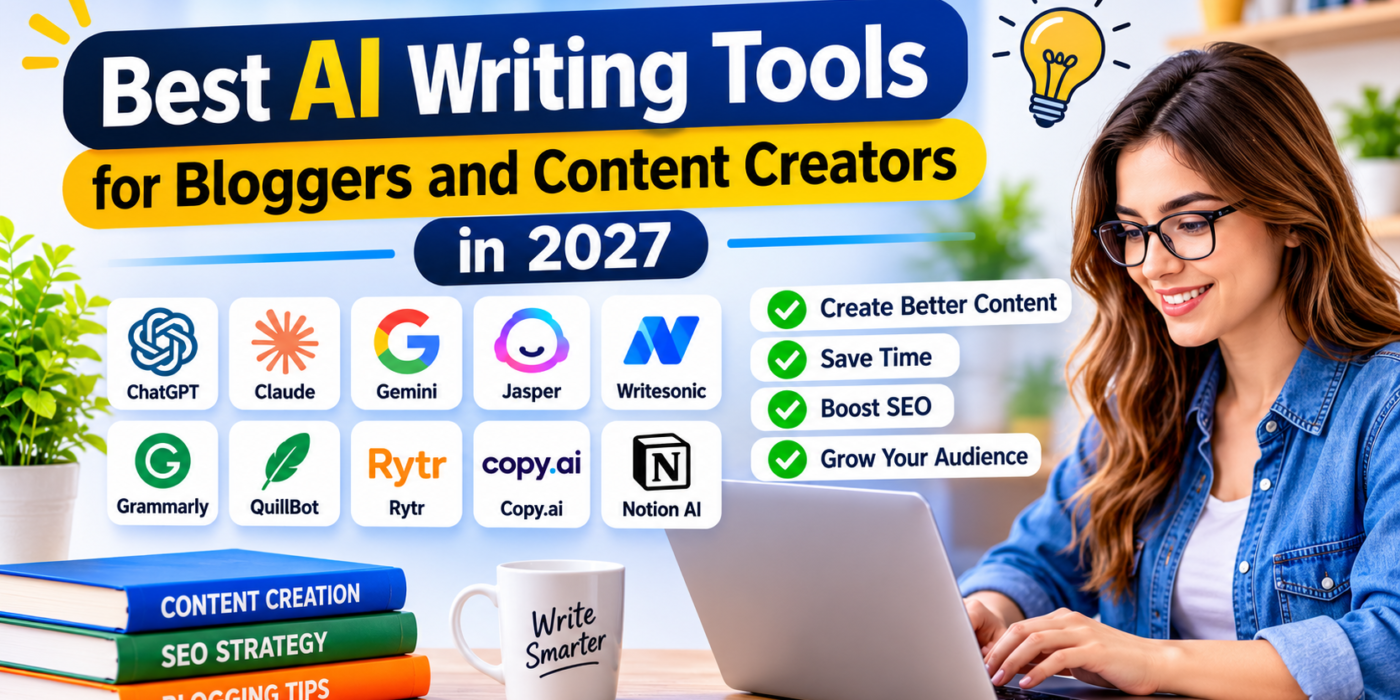
Best AI Writing Tools for Bloggers and Content Creators in 2027

Artificial intelligence is transforming the way bloggers, marketers, freelance writers, and content creators produce online content. Tasks that previously required hours of research, brainstorming, writing, and editing can now be completed much faster with the help of AI writing tools.
Whether you manage a personal blog, operate an affiliate website, publish product reviews, or create content for clients, the right AI writing assistant can help you become more productive without sacrificing content quality.
However, choosing the right platform can be challenging. There are dozens of AI writing tools available, each offering different features, writing capabilities, SEO integrations, and pricing plans.
Some tools are excellent for generating long-form blog articles, while others are better for grammar correction, rewriting, marketing copy, and search engine optimization.

In this guide, we will explore the 10 best AI writing tools for bloggers and content creators in 2027, including their main features, benefits, limitations, and ideal use cases.
Let’s get started!
Quick Comparison: Best AI Writing Tools
If you are looking for a quick recommendation, here is an overview of some popular AI writing platforms.
| AI Writing Tool | Best For | Free Option |
|---|---|---|
| ChatGPT | All-around content creation | Yes |
| Claude | Long-form blog writing | Yes |
| Google Gemini | Research and content creation | Yes |
| Jasper AI | Marketing content | Trial |
| Writesonic | SEO-focused content | Limited access |
| Grammarly | Grammar and editing | Yes |
| QuillBot | Paraphrasing and rewriting | Yes |
| Rytr | Budget-friendly writing | Yes |
| Copy.ai | Marketing copy and workflows | Plan-dependent |
| Notion AI | Content organization | Limited access |
Note: Free access, features, usage limits, and subscription prices can change. Check the official websites for the latest plans.
1. ChatGPT – Best Overall AI Writing Tool
ChatGPT is one of the most versatile AI writing assistants available today. Developed by OpenAI, it helps bloggers and content creators generate ideas, research topics, create outlines, write articles, and improve existing content.
Whether you need a 2,000-word blog post, an engaging introduction, social media captions, product descriptions, or email newsletters, ChatGPT can assist with different types of writing tasks.
One of its biggest advantages is flexibility. Instead of relying on predefined templates, users can provide detailed instructions and customize the output according to their preferred writing style.
Key Features
- Blog post and article generation.
- Content outlines and topic brainstorming.
- SEO-friendly title and meta description suggestions.
- Content rewriting and editing.
- Social media and email content creation.
- Image generation capabilities.
- Research and document analysis.
- Multiple writing styles and tones.
Pros
- Versatile writing and brainstorming capabilities.
- Easy-to-use conversational interface.
- Useful for both beginners and experienced writers.
- Supports different content formats.
- Offers free access with usage limits.
Cons
- Generated content requires human editing.
- Some factual information may need verification.
- SEO performance is not guaranteed.
- Advanced features and usage limits depend on the subscription.
Best For: Bloggers, affiliate marketers, freelance writers, digital marketers, and businesses looking for an all-purpose AI assistant.
Website: https://chatgpt.com/
2. Claude – Best for Long-Form Content Writing
Claude, developed by Anthropic, is another powerful AI assistant for bloggers and professional content creators.
It is particularly useful for people who prioritize natural-sounding writing, detailed explanations, and well-structured articles.
Claude can help create comprehensive blog posts, develop content outlines, summarize research materials, and improve existing drafts.
For bloggers who regularly publish tutorials, guides, educational content, and detailed product reviews, Claude is worth considering.
Key Features
- Long-form article drafting.
- Content editing and rewriting.
- Research document analysis.
- Detailed explanations and summaries.
- Natural writing styles.
- Brainstorming and content planning.
- Projects for organizing related work.
Pros
- Produces detailed and readable drafts.
- Useful for lengthy documents.
- Good at restructuring and improving existing content.
- Supports different writing styles.
- Offers a free option.
Cons
- Usage limits apply.
- SEO keyword research is not its primary purpose.
- Important claims still require fact-checking.
- Advanced features require a paid subscription.
Best For: Professional bloggers, long-form writers, content strategists, and people who regularly create detailed articles.
Website: https://claude.ai/
3. Google Gemini – Best for Research and Content Creation
Google Gemini is Google’s AI assistant and another useful platform for bloggers and content creators.
It can help users brainstorm blog topics, generate article outlines, summarize information, write content, and develop ideas for different digital marketing campaigns.
Gemini is especially worth exploring if you already use Google products and services as part of your content workflow.
Its ability to work with different types of information also makes it useful for research and planning.
Key Features
- Blog topic generation.
- Article outlines and content drafts.
- Research assistance.
- Content summarization.
- Writing improvement and rewriting.
- Image understanding and other multimodal capabilities.
- Integration with supported Google services.
Pros
- Easy to access through a Google account.
- Useful for brainstorming and research.
- Supports different content formats.
- Free access is available.
- Works well alongside supported Google Workspace products.
Cons
- Generated information needs verification.
- Output quality can vary depending on the prompt.
- Some integrations require eligible plans.
- Not a replacement for specialist SEO research tools.
Best For: Bloggers, researchers, students, and content creators who use Google’s ecosystem.
Website: https://gemini.google.com/
4. Jasper AI – Best for Marketing Content
Jasper AI is a specialized AI content platform designed primarily for marketing teams, businesses, and professional content creators.
Unlike general-purpose AI assistants, Jasper focuses on producing marketing content while helping organizations maintain consistent brand messaging.
It can assist with blog articles, advertising copy, product descriptions, landing page content, and social media campaigns.
Its brand voice capabilities are particularly useful for businesses that publish content across multiple platforms and want to maintain a consistent communication style.
Key Features
- AI blog writing.
- Marketing copy generation.
- Brand Voice customization.
- Campaign content creation.
- Content templates.
- Team collaboration.
- Marketing workflow support.
Pros
- Designed specifically for marketing workflows.
- Useful brand consistency features.
- Supports multiple content formats.
- Suitable for teams and businesses.
- Helps organize content production.
Cons
- Paid plans may be expensive for individual bloggers.
- Some features are more useful for marketing teams.
- Generated content still needs editing.
- May offer more functionality than a beginner blogger needs.
Best For: Marketing agencies, content teams, businesses, and professional marketers.
Website: https://www.jasper.ai/
5. Writesonic – Best for SEO-Focused Content
Writesonic is an AI-powered content platform that combines writing assistance with SEO and AI search visibility features.
It is particularly interesting for bloggers who publish search-focused articles and want assistance with content planning, optimization, and online visibility.
The platform offers tools designed to support article creation, content research, and marketing activities.
For affiliate marketers and website owners, Writesonic is worth evaluating as part of a broader SEO content strategy.
Key Features
- AI article generation.
- SEO-focused content assistance.
- Content rewriting.
- Article research.
- Keyword-related content workflows.
- AI search visibility features.
- Content optimization assistance.
Pros
- Designed for content marketing workflows.
- Useful for SEO-focused publishers.
- Combines multiple content-related capabilities.
- Suitable for businesses producing regular articles.
- Offers tools beyond basic text generation.
Cons
- Advanced features may require paid plans.
- Not every feature is necessary for smaller blogs.
- Generated articles require fact-checking.
- SEO results depend on overall content quality and competition.
Best For: SEO bloggers, affiliate marketers, content agencies, and businesses focused on organic traffic.
Website: https://writesonic.com/
6. Grammarly – Best for Grammar and Content Editing
Writing a good article involves more than generating text. Grammar, readability, sentence structure, and clarity are equally important.
Grammarly is a popular writing assistant that helps users improve the quality of their written content.
It identifies grammatical mistakes, spelling errors, punctuation issues, and opportunities to improve sentence clarity.
Its AI-powered writing features can also help users rewrite sentences, adjust tone, and make their communication more professional.
For bloggers who already have a draft but want to polish it before publishing, Grammarly is a valuable addition to their writing workflow.
Key Features
- Grammar and spelling correction.
- Punctuation checking.
- Sentence clarity suggestions.
- Tone detection.
- AI-powered rewriting.
- Writing improvement suggestions.
- Browser and application integrations.
Pros
- Easy to use.
- Helps improve writing quality.
- Useful for proofreading blog articles.
- Works across supported applications.
- Offers a free version.
Cons
- Primarily an editing tool rather than a complete blog generator.
- Some advanced features require payment.
- Suggestions should be reviewed before accepting.
- It cannot independently verify every factual claim.
Best For: Bloggers, students, freelance writers, editors, and professionals who want polished writing.
Website: https://www.grammarly.com/
7. QuillBot – Best for Paraphrasing and Rewriting
QuillBot is an AI-powered writing platform that helps users rewrite, summarize, and improve existing text.
It is particularly useful when you want to make your sentences clearer, adjust the tone of a paragraph, or create a more concise version of an existing draft.
Bloggers can use QuillBot to improve their writing style and identify alternative ways to communicate an idea.
However, paraphrasing should never be used as a substitute for original research or proper attribution. Always credit original sources when required.
Key Features
- AI paraphrasing.
- Grammar checking.
- Text summarization.
- Sentence rewriting.
- Writing assistance.
- Citation-related tools.
- Translation features.
Pros
- Simple interface.
- Useful for improving existing drafts.
- Multiple rewriting options.
- Helpful summarization features.
- Free access is available.
Cons
- Not primarily designed for complete blog production.
- Free usage has limitations.
- Rewritten text still needs review.
- Paraphrasing does not automatically make content original or accurate.
Best For: Students, bloggers, editors, and writers who regularly revise existing content.
Website: https://quillbot.com/
8. Rytr – Best Budget-Friendly AI Writing Tool
Rytr is an AI writing assistant designed to help users generate short-form and marketing content.
It offers writing templates and tools for creating different types of content, including blog ideas, introductions, product descriptions, emails, and social media posts.
Its straightforward interface makes it suitable for people who are new to AI-assisted writing.
For independent bloggers who want to experiment with AI writing without investing in an expensive marketing platform, Rytr is worth exploring.
Key Features
- Blog idea generation.
- Article introductions.
- Product descriptions.
- Email writing.
- Social media content.
- Writing tone options.
- Content templates.
Pros
- Beginner-friendly interface.
- Useful for short-form writing.
- Multiple content templates.
- Suitable for small writing tasks.
- Offers a free option.
Cons
- Long-form content may need substantial editing.
- Advanced functionality depends on the plan.
- Less comprehensive than general-purpose AI assistants.
- Does not replace dedicated SEO research platforms.
Best For: Beginners, small businesses, freelance writers, and bloggers working with limited budgets.
Website: https://rytr.me/
9. Copy.ai – Best for Marketing Copy and Content Workflows
Copy.ai is an AI-powered platform focused on marketing, sales, and business content workflows.
It can help users develop marketing messages, create advertising copy, generate content ideas, and organize repetitive writing tasks.
For bloggers who also manage newsletters, promotional campaigns, and social media content, Copy.ai may help streamline several activities.
Its workflow-oriented approach makes it particularly relevant for businesses and marketing teams.
Key Features
- Marketing copy generation.
- Content brainstorming.
- Sales and marketing workflows.
- Brand voice support.
- Social media content.
- Email copywriting.
- Workflow automation capabilities.
Pros
- Useful for marketing-related content.
- Supports multiple business writing tasks.
- Helps streamline repetitive workflows.
- Suitable for marketing teams.
- Offers different workflow capabilities.
Cons
- Some advanced features are aimed at businesses.
- Pricing depends on the selected plan.
- Not every blogger needs its full functionality.
- Generated copy still requires human review.
Best For: Marketing professionals, businesses, agencies, and content teams.
Website: https://www.copy.ai/
10. Notion AI – Best for Content Planning and Organization
Notion AI is a useful option for bloggers who want to organize their content ideas, research, writing drafts, and publishing schedules in one workspace.
Notion is already popular for note-taking, project management, and documentation. Its AI capabilities add writing and summarization assistance to that environment.
Instead of switching between multiple applications, bloggers can use Notion to manage their editorial calendar, store article ideas, organize research, and work on drafts.
Key Features
- AI writing assistance.
- Content summarization.
- Article brainstorming.
- Document editing.
- Meeting and note summaries.
- Content planning.
- Workspace organization.
Pros
- Combines writing and organization.
- Useful for managing editorial calendars.
- Helps organize research materials.
- Supports team collaboration.
- Suitable for long-term content planning.
Cons
- Advanced AI functionality may require a paid plan.
- Not a dedicated SEO optimization platform.
- Beginners may need time to learn the workspace.
- AI writing capabilities are only one part of the overall product.
Best For: Bloggers, content managers, editorial teams, and businesses managing multiple content projects.
Website: https://www.notion.com/
Best AI Writing Tools: Detailed Comparison
Choosing the right tool depends on your writing requirements, budget, and publishing goals.
Here is another comparison based on the primary purpose of each platform.
| Tool | Main Strength | Ideal User |
|---|---|---|
| ChatGPT | Versatile AI writing | General bloggers |
| Claude | Detailed writing | Long-form writers |
| Gemini | Research assistance | Researchers and bloggers |
| Jasper | Marketing content | Marketing teams |
| Writesonic | SEO content workflows | SEO publishers |
| Grammarly | Editing and proofreading | Professional writers |
| QuillBot | Paraphrasing | Editors and students |
| Rytr | Short-form content | Beginners |
| Copy.ai | Marketing workflows | Businesses |
| Notion AI | Content organization | Content managers |
How to Choose the Right AI Writing Tool for Your Blog
Before subscribing to an AI writing platform, consider what you actually need.
Not every blogger requires an expensive AI writing subscription. Some creators only need assistance with brainstorming, while others need advanced content optimization and team collaboration.

Here are several important factors to consider.
1. Understand Your Content Requirements
Start by identifying the type of content you publish regularly.
For example:
- Affiliate websites need product comparisons and reviews.
- Personal blogs need engaging articles and storytelling.
- Business websites need professional website copy.
- SEO blogs need keyword-focused informational content.
- Marketing agencies need content for multiple clients.
Choose a platform that matches your publishing requirements.
2. Consider Your Budget
Many AI writing platforms offer free access or limited trials.
If you are starting a new blog, begin with free tools before purchasing multiple subscriptions.
You can initially use a general AI assistant for brainstorming and drafting, then add specialist tools when you identify a genuine need.
3. Check SEO Capabilities
If your primary goal is generating organic traffic, look beyond basic article generation.
Consider whether the platform supports:
- Content planning.
- Keyword research assistance.
- Search intent analysis.
- Article structure suggestions.
- Internal linking recommendations.
- Content optimization.
Remember that an AI writing tool cannot guarantee Google rankings.
4. Evaluate Content Quality
A good AI writing platform should help you create readable, informative, and useful content.
Test the tools with the same topic and compare their output.
Look at:
- Accuracy.
- Readability.
- Sentence structure.
- Content organization.
- Relevance to your audience.
- Amount of editing required.
5. Check Integration Options
Consider how easily the writing tool fits into your existing workflow.
For example, bloggers using WordPress may prefer tools that make it easy to transfer drafts, format content, and manage their publishing process.
Other useful integrations may include Google Docs, content management systems, browser extensions, and project management platforms.
How to Use AI Writing Tools to Create Better Blog Posts
Using AI does not mean publishing everything it generates without reviewing it.
The best approach is to combine AI assistance with human research, expertise, and editorial judgment.
Here is a practical workflow for creating a high-quality blog article.
Step 1: Find a Relevant Topic
Start with a topic that your target audience is actively interested in.
Use keyword research tools and search engine results to identify relevant questions and search intent.
For example, if you operate an AI tools blog, potential topics include:
- Best AI Tools for Small Businesses.
- Best AI Writing Tools for Bloggers.
- Best Free AI Tools for Content Creation.
- AI Tools for Affiliate Marketing.
- Best AI Tools for SEO Professionals.
Step 2: Create a Detailed Article Outline
Use an AI assistant to develop a logical structure for your article.
Include the main headings, supporting sections, FAQs, and relevant comparison tables.
A good outline makes the writing process more organized.
Step 3: Research the Information
Research each tool using its official website, product documentation, and reliable third-party sources.
Check features, limitations, subscription plans, and recent updates.
Do not rely entirely on AI-generated information.
Step 4: Generate the First Draft
Use your selected writing assistant to develop the article based on your outline.
Provide detailed instructions about the target audience, writing style, article length, and information requirements.
Step 5: Edit and Improve the Content
Review the draft carefully.
Remove unnecessary repetition, improve explanations, add practical examples, and correct any inaccurate information.
You can use Grammarly or other editing tools to improve readability.
Step 6: Optimize for SEO
Before publishing, make sure your article has:
- A clear SEO title.
- A relevant meta description.
- A descriptive URL.
- Proper heading structure.
- Relevant keywords used naturally.
- Useful internal links.
- Appropriate image alt text.
- Helpful FAQs where relevant.
Step 7: Publish and Update
Publish your article on WordPress and monitor its performance through Google Search Console and analytics tools.
Update the content when products, features, or pricing information changes.

Can AI-Generated Content Rank on Google?
Yes, AI-assisted content can appear in Google Search results.
Google’s approach focuses on content quality rather than simply whether AI was used to create it.
However, generating large volumes of low-quality, repetitive, or unhelpful articles can create problems.
To create useful content, focus on:
Originality: Include your own insights, examples, and meaningful analysis.
Accuracy: Verify statistics, product features, and other factual information.
Experience: Where possible, test the tools and share genuine observations.
Readability: Write for people rather than trying to insert keywords into every paragraph.
Value: Answer the reader’s questions more effectively than a generic article would.
AI should support your content creation process, not replace editorial responsibility.
Frequently Asked Questions (FAQs)
1. What is the best AI writing tool for bloggers?
ChatGPT is a strong all-around choice because it supports brainstorming, research assistance, outlining, drafting, rewriting, and editing. Claude is another excellent option for long-form content.
2. Are there any free AI writing tools?
Yes. ChatGPT, Claude, Google Gemini, Grammarly, QuillBot, and Rytr offer free access or free usage options. However, features and usage limits vary.
3. Can AI writing tools create complete blog articles?
Yes. Many AI assistants can generate complete article drafts, including introductions, headings, paragraphs, and conclusions. However, these drafts should be researched, edited, and fact-checked before publication.
4. Which AI writing tool is best for SEO?
Writesonic is worth considering for SEO-focused content workflows. ChatGPT and Gemini can also assist with content planning and SEO-related writing tasks. For advanced optimization, consider using dedicated SEO platforms alongside your AI writing assistant.
5. Can beginners use AI writing tools?
Absolutely. Most AI writing assistants have simple interfaces and do not require technical knowledge. Beginners can use them to generate ideas, organize articles, and improve their writing.
6. Are paid AI writing tools worth the money?
It depends on how frequently you create content and which features you need. If you publish regularly or manage multiple websites, a paid subscription may save time. Occasional bloggers may find free plans sufficient.
7. Should I publish AI-generated content without editing?
No. Always review AI-generated content before publishing. Check facts, improve readability, add original insights, and ensure that the article provides genuine value to readers.
8. Do AI writing tools replace human writers?
AI tools can automate several writing tasks, but human judgment, creativity, experience, research, and editorial skills remain important. The best results usually come from combining AI assistance with human expertise.
Final Thoughts: Which AI Writing Tool Should You Choose?
AI writing tools have become valuable resources for bloggers, content creators, marketers, and businesses.
However, the best platform depends on your specific requirements.
If you need an all-purpose writing assistant, ChatGPT is a strong starting point. If you prioritize detailed long-form writing, consider Claude. For SEO-focused content workflows, explore Writesonic. If grammar and proofreading are your main concerns, Grammarly is worth considering.
For marketing teams, Jasper and Copy.ai offer specialized features, while Notion AI can help organize your entire content workflow.
Our recommendation is to start with one general-purpose AI writing assistant and add specialist tools only when necessary.
Most importantly, remember that successful blogging is not about publishing the largest number of AI-generated articles. It is about creating useful, accurate, original, and engaging content that genuinely helps your readers.
Choose the right tools, combine AI with human creativity, and build a content strategy that delivers long-term value.