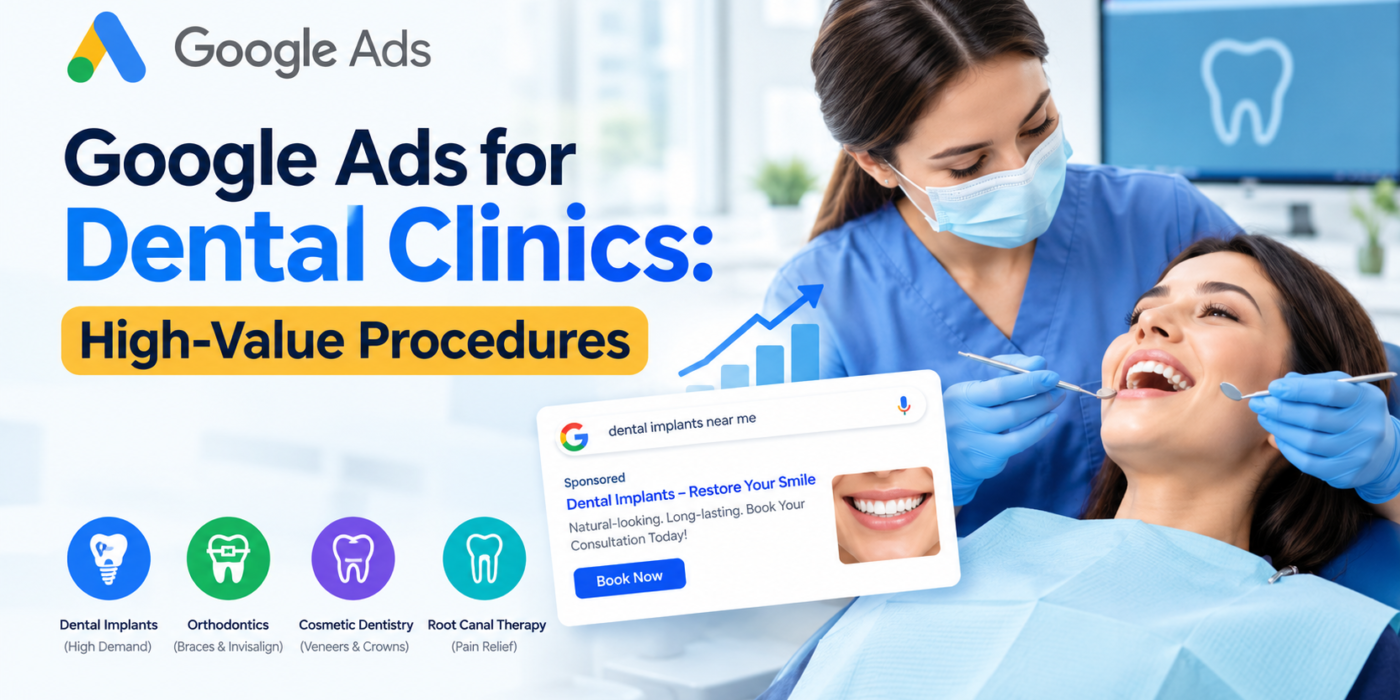
Google Ads for Dental Clinics: High-Value Procedures
Introduction
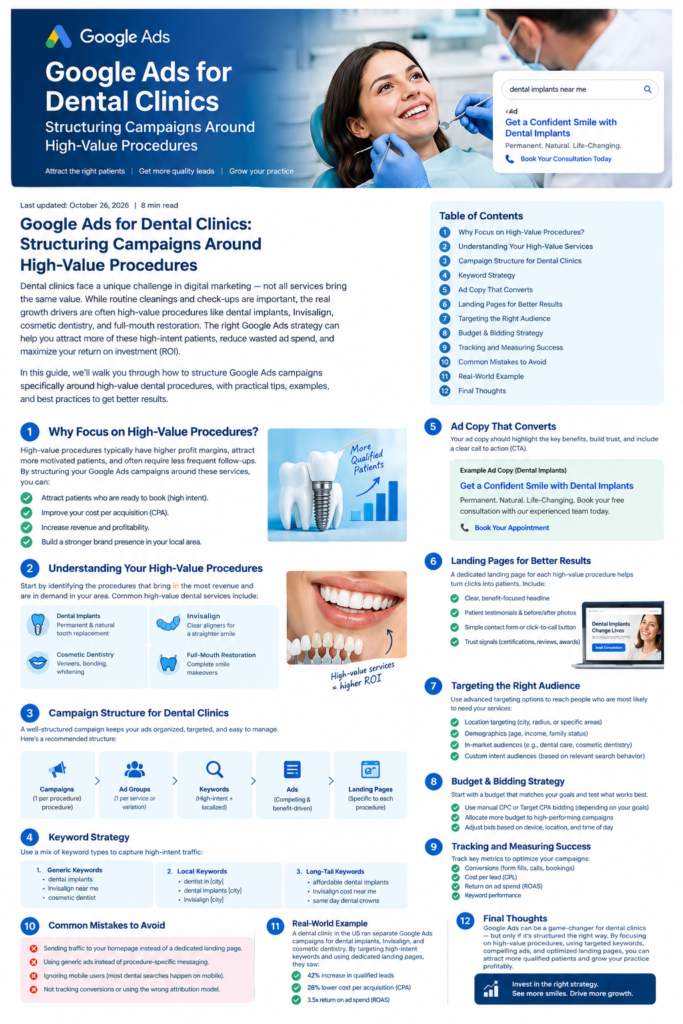
Dental clinics often promote a broad list of services, but not every treatment has the same value, patient journey, or booking process. Routine check-ups and hygiene appointments are important to a healthy practice, while treatments such as dental implants, Invisalign, cosmetic dentistry, and full-mouth rehabilitation may require more research and can represent a higher-value opportunity for the clinic.
Google Ads can help a practice appear when prospective patients actively search for a service. The goal is not simply to generate more clicks. It is to attract suitable enquiries, help patients understand their options, and turn those enquiries into attended consultations and accepted treatment plans.
This guide explains how to structure campaigns around high-value procedures, choose intent-focused keywords, build dedicated landing pages, measure results responsibly, and improve performance over time. Results depend on local demand, competition, budget, clinical capacity, and the practice’s consultation and follow-up process.
1. Start by identifying your high-value procedures
Before building campaigns, agree on which services deserve dedicated investment. Review practice goals, treatment capacity, historical enquiry quality, consultation attendance, treatment acceptance, and contribution margin with the clinic owner or practice manager. Revenue alone is not enough: account for clinician time, lab fees, materials, financing costs, and other variable expenses when comparing services.
Common candidates for separate campaigns include:
Dental implants and implant-supported restorations
Clear aligners, including Invisalign where the clinic is an authorized provider
Cosmetic dentistry, such as veneers, bonding, and smile makeovers
Teeth whitening, where commercially appropriate
Crowns, bridges, and complex restorative treatment
Full-mouth rehabilitation or other specialist services
Do not assume a procedure is automatically profitable or appropriate for paid search. Check local search demand, the clinic’s clinical expertise, appointment availability, average treatment value, lead-to-consultation rate, and the cost of acquiring a new patient. A lower-value service can still be a good campaign if it supports long-term patient relationships or fills unused capacity.
2. Build campaigns around distinct services and intent
A useful starting structure is to separate campaigns by procedure when the services have different economics, messaging, landing pages, or budgets. This gives the advertiser clearer control over spend and makes reporting more meaningful.
Example structure:
Campaign: Dental Implants — ad groups for dental implants, implant consultation, and implant-supported teeth where search volume supports the split.
Campaign: Clear Aligners — ad groups for clear aligners, Invisalign, and adult orthodontic consultations, using accurate provider and brand wording.
Campaign: Cosmetic Dentistry — ad groups for veneers, cosmetic bonding, and smile makeover searches.
Campaign: Restorative Dentistry — ad groups for crowns, bridges, or other relevant treatments.
Campaign: General Dentistry — check-ups, hygiene, and other routine services, if the clinic wants to acquire those patients.
Keep the structure simple enough to manage. Very small ad groups can fragment data and slow optimization. Start with a focused set of campaigns, then split them only when search volume, budget, performance, or different landing-page needs justify it.
Use location settings that reflect the real service area. A clinic that serves one city or a defined catchment should not automatically target an entire country. Review the actual geographic options available in the account and monitor where clicks and qualified enquiries originate.
3. Choose keywords based on intent
High-intent searches often include a procedure and a location, or indicate that the person is comparing providers or ready to arrange a consultation. Examples include:
“dental implants [city]”
“dental implant consultation near me”
“clear aligners [city]”
“Invisalign dentist [city]”
“porcelain veneers [city]”
“cosmetic dentist consultation [city]”
“dental crown cost [city]”
Build keyword lists from real search behaviour, then validate them with Keyword Planner and the Search Terms report. Phrase and exact match can help establish a controlled starting point, but match types are not literal guarantees of the query that triggers an ad. Search-term reviews remain essential.
Add negative keywords thoughtfully to reduce irrelevant spend. Depending on the practice, these may include terms such as jobs, careers, training, course, school, DIY, or free materials. Do not exclude a word simply because it looks broad: searches about cost, payment plans, insurance, or financing may be valuable if the clinic offers relevant options.
Separate research-oriented searches from ready-to-book searches when it improves reporting or messaging. For example, “what are dental implants” may need educational content, while “dental implant consultation [city]” is more directly transactional. Do not force every query into a consultation campaign if the landing page cannot answer the searcher’s question.
4. Write specific, trustworthy ad copy
Ad copy should reflect the procedure, location, and next step. Avoid vague claims such as “Best Dentist Ever” or unsupported promises about outcomes. Use only claims the clinic can substantiate and that comply with applicable advertising rules and platform policies.
Useful message elements include:
The exact service, such as dental implants or clear aligner consultations
The clinic’s location or relevant service area
A genuine differentiator, such as an experienced clinical team, consultation availability, accessible location, or documented technology
Practical information the clinic can verify, such as payment options or opening hours
A clear call to action, such as “Request a Consultation” or “Discuss Your Options”
Example ad concept for implants:
Headline ideas: “Dental Implant Consultations” | “Explore Tooth Replacement Options” | “Appointments in [City]”
Description idea: “Discuss your tooth-replacement options with our dental team. Learn about the consultation process and available treatment options. Request an appointment.”
Example ad concept for clear aligners:
Headline ideas: “Clear Aligner Consultation” | “Explore Straighter-Smile Options” | “Dental Team in [City]”
Description idea: “Find out whether clear aligners may suit your needs. Arrange a consultation to discuss the process, timeline, and costs with the clinic.”
These are starting points, not guarantees of approval or performance. Check character limits, destination requirements, trademarks, and local rules before publishing. Use responsive search ads with relevant assets, but keep every headline and description accurate when combinations are shown.
5. Create a dedicated landing page for each procedure
Sending every ad to the homepage creates friction. A person searching for dental implants should land on a page that clearly explains the clinic’s implant service, rather than having to search the website again.
A strong procedure landing page usually includes:
A headline that matches the ad and search intent
A plain-language explanation of the service and who may want to discuss it
What happens during an initial consultation
The clinician’s relevant qualifications and experience, accurately represented
Transparent pricing guidance or an explanation of how costs are assessed, where possible
Genuine patient reviews or testimonials used with permission and in line with local rules
Clear, real photographs where appropriate, with consent and no misleading before-and-after presentation
Answers to common questions, including treatment process, timing, aftercare, and payment options
A visible phone number and short appointment request form
Mobile-friendly design, accessible text, and fast loading
Use one primary action on the page, such as calling the clinic or requesting a consultation. If both options are important, present them clearly without overwhelming the visitor. Keep forms short, explain how the clinic will use submitted information, and avoid asking for detailed medical information unless it is genuinely needed and handled through an appropriate secure process.
Do not promise that a procedure is suitable for every visitor. Clinical suitability is determined by a qualified dental professional after appropriate assessment. The page should invite a conversation, not attempt to diagnose the visitor.
6. Make the enquiry-to-appointment journey easy
Campaign performance depends on more than ad settings. Make sure calls and forms reach a team member who can respond promptly, explain the next step, and book an appropriate appointment. Establish a process for missed calls, after-hours enquiries, follow-up attempts, and recording appointment outcomes.
Track the stages that matter to the practice: enquiry received, contact made, consultation booked, consultation attended, treatment plan presented, and treatment accepted. Use consistent definitions so that marketing and reception teams interpret lead quality in the same way.
Review call handling and form quality regularly. A campaign can generate many enquiries but still underperform if the clinic cannot contact people, has limited appointment availability, or receives enquiries outside its service area.
7. Target the right geography and audiences
Location is often a major factor in dental search behaviour. Start with a realistic radius or a set of areas that patients are likely to travel from, then adjust based on qualified enquiries and clinic capacity. Avoid expanding just to spend the budget.
Search campaigns usually capture active intent, so keyword and location relevance should lead the strategy. Audience segments can be used for observation and analysis where available, but do not rely on demographic assumptions to decide who should receive care. Dental treatment decisions vary widely by individual.
Be especially careful with health-related advertising and personalization. Dental information may be considered sensitive in some jurisdictions. Do not build audiences from patient lists, inferred conditions, or treatment-page visitors unless the use is explicitly permitted by current platform rules, privacy law, consent requirements, and the clinic’s compliance process. Review Google’s current personalized advertising policies before using remarketing or customer data.
8. Set a realistic budget and bidding approach
Estimate budget using local click costs, expected conversion rates, and the clinic’s acceptable cost per qualified enquiry—not a generic industry benchmark. For example, if the expected cost per click is £5 and the campaign receives 200 clicks, media spend would be about £1,000 before fees and taxes. The number of enquiries will depend on the landing page, search intent, competition, and follow-up process.
Set a target cost per qualified lead only after understanding the clinic’s economics. A simple planning model is:
Expected cost per lead = average cost per click ÷ landing-page conversion rate.
For example, a £5 average click cost and a 5% conversion rate imply an estimated £100 per lead. This is a planning illustration, not a forecast or benchmark. If only half of those leads qualify, the cost per qualified lead would be higher.
Start with a bidding strategy that matches the amount and reliability of conversion data available. Avoid changing several major variables at once. Once tracking is reliable and enough meaningful conversion data has accumulated, test automated bidding strategies against clearly defined business goals. Set budgets by procedure based on demand, profitability, appointment capacity, and lead quality—not merely by which campaign produces the most form submissions.
9. Track meaningful conversions while protecting patient privacy
At minimum, configure and test the conversion actions that reflect real intent, such as a successfully submitted appointment request or a qualified call of sufficient duration. A click on a phone number is not the same as a connected call, and a form start is not the same as a completed enquiry.
Where possible, import qualified outcomes or offline conversions using a method approved for the account and compliant with the clinic’s obligations. Avoid sending patient names, email addresses, phone numbers, appointment details, diagnoses, treatment details, or other sensitive health information to advertising platforms unless a specific lawful and platform-approved method has been confirmed. Do not place sensitive information in URLs, analytics event names, form field values, or free-text parameters.
Use consent management and privacy notices appropriate to the clinic’s jurisdiction. Limit access to patient information, define retention periods, and work with the clinic’s privacy or compliance lead before enabling tags, call recording, enhanced conversions, customer-list uploads, or integrations involving patient data. Rules differ by country and platform policy can change, so verify current requirements before implementation.
Review both platform-reported conversions and the clinic’s own appointment records. Reporting differences can arise from attribution windows, consent choices, call tracking, duplicate events, and cross-device behaviour. The aim is a dependable measurement system, not a misleadingly high conversion count.
10. Avoid common campaign mistakes
Sending all traffic to the homepage instead of a relevant procedure page.
Combining very different services under one campaign with no budget or reporting control.
Using broad keywords without regular search-term reviews.
Forgetting negative keywords and allowing job, training, or unrelated searches to consume spend.
Optimizing for low-quality form submissions rather than qualified enquiries and attended consultations.
Using unverified claims, unrealistic guarantees, or misleading pricing.
Ignoring mobile speed, phone usability, or missed calls.
Expanding the target area before proving results in the core catchment.
Making frequent bid, budget, keyword, and landing-page changes simultaneously.
Installing tracking tags or uploading patient data without a privacy and policy review.
11. Example: a practical 90-day optimization plan
Consider a fictional clinic offering implants, clear aligners, and general dentistry. The following is an illustrative workflow, not a performance guarantee.
Days 1–30: Establish the baseline. Review search demand, competition, service economics, clinic capacity, existing account history, conversion tracking, call handling, and landing pages. Launch a small number of focused campaigns and ensure each has accurate ads, relevant keywords, location settings, and a suitable destination page.
Days 31–60: Improve relevance and lead quality. Review search terms, add negatives, compare device and location performance, listen to call outcomes where lawful and appropriately disclosed, and speak with reception about enquiry quality. Test one or two landing-page improvements, such as clearer consultation information or a shorter form.
Days 61–90: Optimize for business outcomes. Compare cost per qualified enquiry, booked consultation, attended consultation, and treatment acceptance where reliable data is available. Shift budget toward services and areas that meet the clinic’s goals, while preserving enough data to make informed decisions. Expand only when the core campaigns and follow-up process are working.
At the end of the period, document what changed, what evidence supports the decision, and what should be tested next. Avoid claiming success based on a small sample or short-term fluctuation.
12. Reporting: focus on business results
Useful reporting should connect advertising activity to patient acquisition. Include spend, clicks, search terms, conversion rate, cost per enquiry, qualified-lead rate, booked consultations, attendance rate, treatment acceptance where the clinic can measure it appropriately, and cost per acquired patient when reliable data exists.
Segment results by procedure, location, device, and landing page where the data volume supports meaningful comparison. Annotate changes such as budget adjustments, tracking fixes, seasonal shifts, and staffing constraints. If data is sparse, report the limitation clearly instead of ranking campaigns on unstable results.
Agree on definitions with the clinic in advance. A ‘lead’ might mean a completed appointment request, while a ‘qualified lead’ might mean a genuine prospective patient within the service area who is interested in a service the clinic provides. Consistent definitions prevent disputes and help marketing decisions reflect actual practice needs.
Conclusion
Successful Google Ads for dental clinics starts with a clear commercial and clinical plan. Identify the procedures that make sense for the practice, organize campaigns around distinct services and intent, use specific keywords and trustworthy ad copy, and send visitors to dedicated landing pages. Then connect advertising data to enquiry quality, booked consultations, and patient acquisition.
Just as importantly, make privacy and policy compliance part of the setup—not an afterthought. Protect patient information, verify current platform requirements, and measure only what the clinic can lawfully and reliably use.
With disciplined testing and close coordination between marketing and the front-desk team, a dental clinic can make better use of its advertising budget and create a more helpful path from a patient’s search to a consultation.
Frequently asked questions
Should dental clinics create a separate Google Ads campaign for every procedure? Not always. Separate campaigns are useful when procedures need different budgets, landing pages, locations, or performance goals. Combine closely related services when search volume is limited and management would otherwise become unnecessarily complex.
Are dental implant keywords always the most profitable? No. Profitability depends on local click costs, clinical capacity, case economics, conversion rates, lead quality, and treatment acceptance. Use the clinic’s own numbers rather than assuming one procedure will outperform another.
How much should a dental clinic spend on Google Ads? There is no universal budget. Estimate from local click costs, expected qualified-lead volume, the clinic’s acceptable acquisition cost, and its ability to handle appointments. Start with a test budget the practice can sustain while gathering useful data.
Should ads send visitors to the homepage? Usually, a dedicated page for the advertised service provides a more relevant experience and clearer next step. The homepage can work for broader searches, but it should not be the default destination for every procedure.
Can a dental clinic use remarketing? Health-related advertising and audience use can be restricted by platform policy and privacy law. Check current Google Ads policies and applicable local requirements before using remarketing, patient lists, or audiences based on health-related activity.
What is the most important conversion to track? Track completed enquiries and qualified calls, then connect them to booked and attended consultations where possible. The best measure is the one that is accurate, useful for decisions, and handled in a privacy-compliant way.