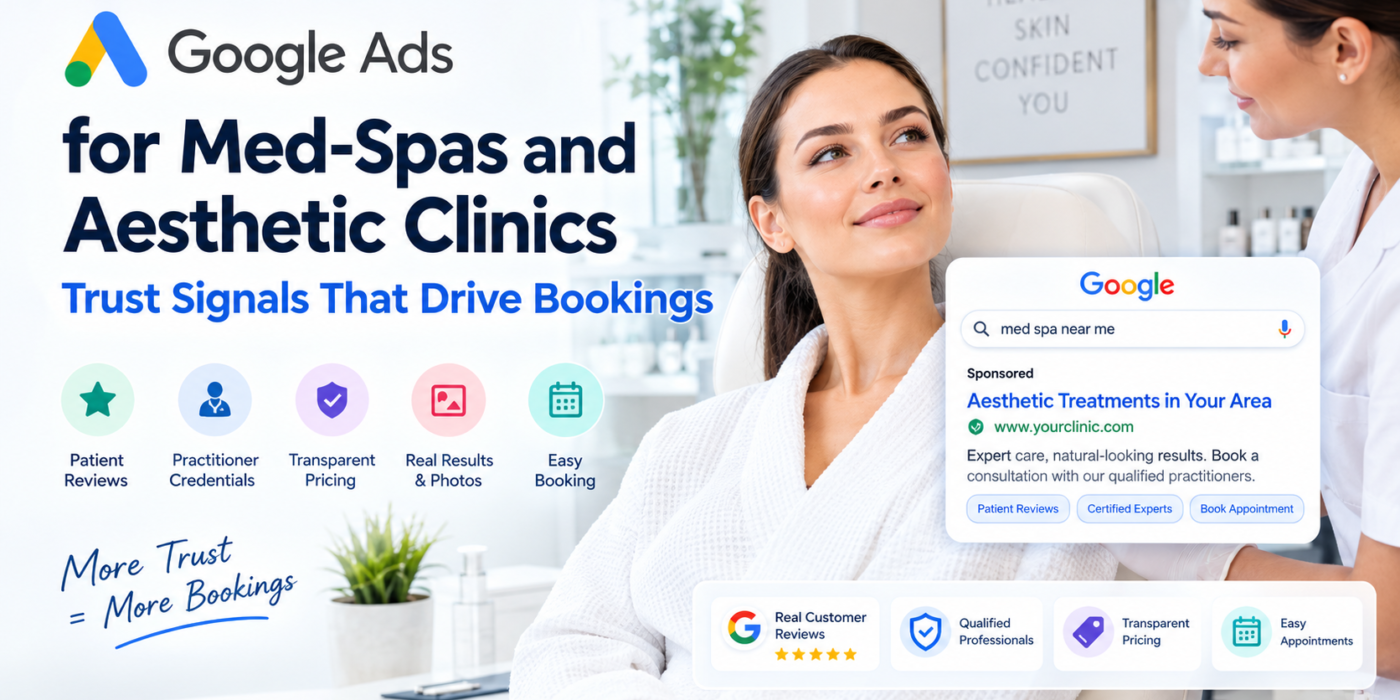
Google Ads for Med-Spas and Aesthetic Clinics: Trust Signals That Drive Bookings
Introduction
Med-spas and aesthetic clinics operate in a competitive market where trust plays a major role in a customer’s decision to book an appointment. People searching for Botox, dermal fillers, laser hair removal, skin rejuvenation, and other aesthetic treatments want more than an attractive offer. They want to know whether a clinic is qualified, whether the treatment is suitable for them, what the experience will be like, and how much it will cost.
Google Ads helps clinics reach people who are actively searching for aesthetic services. However, getting someone to click an ad is only the first step. Turning that click into a consultation or appointment requires a website that answers questions, establishes credibility, and makes the booking process straightforward.
This is where trust signals become important.
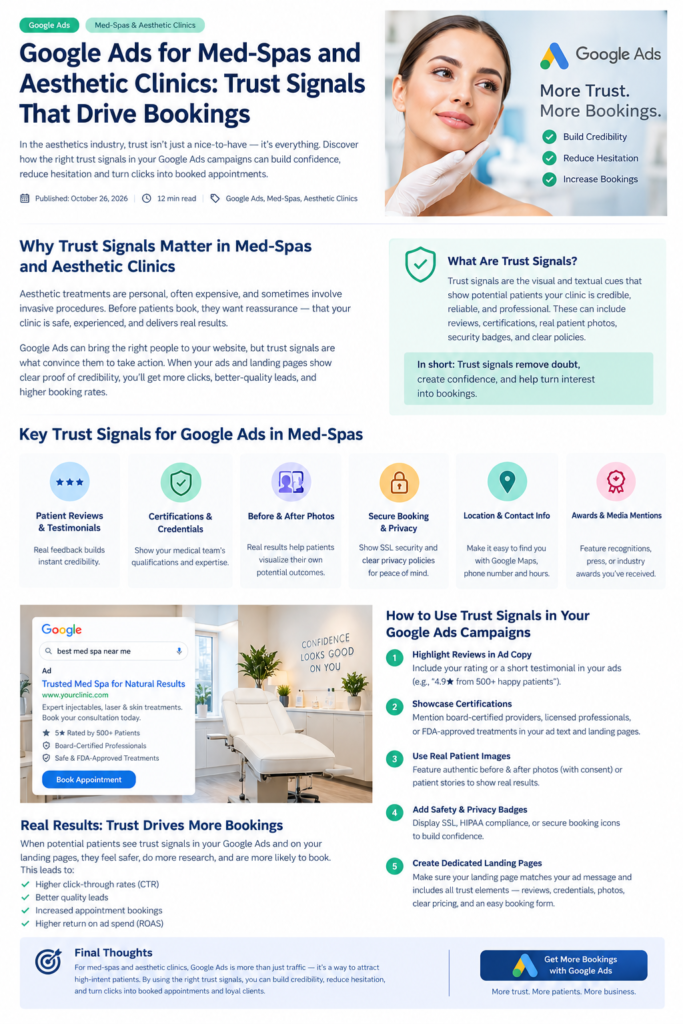
Trust signals are elements that help potential clients evaluate your clinic before contacting you. These include genuine patient reviews, practitioner credentials, authentic treatment photographs, transparent pricing, clear contact information, and secure booking options.
For med-spas and aesthetic clinics, these signals can help reduce hesitation and make the decision-making process easier.
In this article, we will explore the most effective trust signals for Google Ads campaigns and explain how to use them to improve the customer journey from search to booking.
Why Trust Signals Matter in Med-Spa Advertising
Aesthetic treatments are personal decisions. Depending on the procedure, prospective clients may have concerns about safety, discomfort, cost, downtime, and the results they can realistically expect.
When several clinics offer similar treatments, customers often look beyond price to decide which provider feels credible and professional.
Strong trust signals can help your clinic:
- Build confidence before a potential client makes contact.
- Demonstrate the experience and qualifications of your practitioners.
- Explain treatments and expectations clearly.
- Differentiate your clinic from local competitors.
- Reduce friction between the advertisement and the booking.
- Encourage more informed consultation requests.
Trust signals do not guarantee conversions, but they can make it easier for qualified prospects to take the next step.
The objective is simple: give people credible information that helps them make an informed decision rather than relying on exaggerated claims or aggressive sales tactics.
1. Use Genuine Patient Reviews and Testimonials
Online reviews are an important part of how people evaluate local aesthetic clinics. Before booking, prospective clients may look at feedback about the consultation process, staff professionalism, communication, and overall experience.
Authentic reviews help demonstrate what real clients have experienced.
How to use reviews effectively
Display genuine feedback. Feature relevant reviews on your website, especially on treatment pages where prospective clients are likely to have questions.
Respond professionally. Thank reviewers for their feedback and handle criticism constructively. Avoid revealing private patient information in public responses.
Make testimonials specific. Feedback describing a clear explanation of the treatment or a comfortable consultation can be more informative than a generic statement.
Obtain permission. If you want to use a client’s photograph, video, name, or detailed story in your advertising, obtain appropriate consent.
Never fabricate reviews, purchase fake feedback, or edit testimonials to change their meaning.
How reviews support Google Ads
Your advertisement may attract attention, but the landing page must provide evidence that supports its message.
For example, if your ad highlights a professional consultation, the page should explain the consultation process and provide credible information about the practitioners delivering the service.
Where eligible, use Google Ads assets that are permitted for your account and business category. Do not assume that every review format or rating extension is available to every advertiser.
Practical tip: Make it easy for visitors to find your clinic’s genuine public reviews without forcing them through multiple pages.
2. Show Authentic Before-and-After Photos
Visual evidence can help prospective clients understand the types of results a clinic has achieved. For relevant treatments, authentic before-and-after photographs may be useful when presented responsibly.
However, these images must accurately represent the treatment experience.
Best practices for treatment photographs
- Use consistent lighting, angles, and image quality.
- Avoid filters, excessive retouching, or edits that exaggerate results.
- Obtain informed permission for marketing use.
- Label photographs clearly.
- Explain the treatment and timeframe where appropriate.
- Make it clear that individual results vary.
Avoid implying that every client will achieve the same outcome. Results depend on individual circumstances, treatment suitability, practitioner assessment, and other factors.
Images should educate potential clients rather than make them feel insecure about their appearance.
Example of a responsible presentation
A treatment page might show authentic, consented photographs alongside an explanation of the procedure, the consultation process, and relevant limitations.
This gives visitors useful context instead of relying on a photograph alone.
Practical tip: Review every image before publishing it in an advertisement or landing page. Confirm that it is genuine, properly authorized, and consistent with the claims made in your marketing.
3. Highlight Practitioner Credentials and Expertise
One of the most important questions a potential client may ask is: Who will perform my treatment?
A polished website and positive reviews are helpful, but prospective clients may still hesitate if they cannot verify the qualifications of the person providing the service.
Make practitioner information easy to find.
What to include
- Practitioner names and professional photographs.
- Accurate qualifications and relevant training.
- Applicable licenses or registrations.
- Relevant treatment experience.
- Current professional memberships, where applicable.
- A clear explanation of which practitioner provides each service.
Avoid vague claims such as “the best aesthetic experts” unless you have a clear, supportable basis for the statement.
Credentials should be accurate and represented honestly. A short training course or professional membership should not be presented as equivalent to a medical license or specialist qualification.
How to incorporate credentials into your landing page
Create a dedicated practitioner section that explains who provides the treatment, their relevant qualifications, and what patients can expect during the consultation.
If someone clicks an ad for an injectable treatment, they should be able to find information about the professional responsible for providing it.
Practical tip: Place relevant practitioner information near the treatment details or consultation call to action rather than hiding it at the bottom of your website.
4. Be Transparent About Treatment Pricing
Unclear pricing can discourage potential clients from booking a consultation.
People may worry about unexpected charges, additional fees, or feeling pressured to purchase a treatment once they arrive.
Transparent pricing helps set realistic expectations.
What should your website explain?
Where possible, include:
- Starting prices or realistic price ranges.
- Consultation fees.
- What is included in each treatment or package.
- Deposit requirements.
- Cancellation and rescheduling terms.
- Whether follow-up or maintenance appointments may be needed.
If the final price depends on an individual assessment, explain what affects the cost and when the client will receive a quote.
Avoid promotional pricing that applies only under narrow conditions unless those conditions are clearly disclosed.
Why pricing transparency matters for PPC
When an advertisement attracts someone who expects a certain price, the landing page should help them understand the actual cost structure.
Clear pricing can also help filter out enquiries that are unlikely to become suitable bookings.
The goal is not necessarily to offer the lowest price. It is to communicate value and expectations honestly.
5. Build Dedicated Landing Pages for Each Treatment

Sending every Google Ads visitor to your homepage can create unnecessary friction.
Consider someone searching for “laser hair removal clinic near me.” If they click your ad and land on a page containing dozens of unrelated treatments, they must search again for the service they originally wanted.
A dedicated landing page provides a more relevant experience.
Essential elements of a high-converting treatment page
A clear headline: State the treatment or service being advertised.
Treatment information: Explain what the procedure involves and who may be suitable for it.
Practitioner details: Identify the qualified professionals responsible for providing the service.
Realistic expectations: Describe relevant risks, limitations, downtime, and aftercare.
Pricing guidance: Explain starting prices or how the clinic determines the final cost.
Genuine reviews: Include relevant feedback and authorized case examples.
A clear call to action: Provide an easy way to request a consultation or appointment.
For example, a laser hair removal advertisement should lead to a page explaining that service, rather than a generic page listing every treatment offered by the clinic.
Match your ad to your landing page
The visitor’s journey should feel consistent.
If the ad promotes a consultation, the landing page should explain what that consultation includes. If the ad promotes a particular location, the page should provide accurate information about that branch.
This consistency helps people find the information they expected when they clicked.
Practical tip: Prioritize dedicated landing pages for the treatments receiving the most advertising spend.
6. Make Booking Simple, Private, and Secure
Even a visitor who trusts your clinic may abandon the process if booking is confusing.
Long forms, slow-loading pages, unclear buttons, and unanswered phone calls can all prevent a potential client from becoming an actual appointment.
Improve the booking experience
Use straightforward calls to action, such as:
- Book a Consultation
- Request an Appointment
- Speak With Our Team
- Check Availability
Keep enquiry forms short and ask only for the information required at that stage.
Make your telephone number, clinic address, opening hours, and response expectations easy to find.
Use a reputable booking system and explain how enquiry information will be handled. Sensitive medical details should not be collected through ordinary marketing forms unless the system and process are appropriate for that information.
Test the complete customer journey
Before launching a campaign, test the process on a mobile device:
- Click the advertisement.
- Check the landing-page loading speed.
- Complete the enquiry form.
- Confirm that the submission succeeds.
- Verify that the clinic receives the enquiry.
- Test the confirmation and follow-up process.
If your clinic receives leads but fails to contact them promptly, increasing the advertising budget may not solve the underlying problem.
Practical tip: Assign responsibility for responding to new enquiries and establish a realistic follow-up process.
7. Write Credible Google Ads Copy
Your ad needs to communicate what the clinic offers and why a prospective client should consider contacting it.
Trustworthy messaging is generally more useful than exaggerated promises.
Example Google Search Ad
SPONSORED SEARCH RESULT — EXAMPLE
Aesthetic Consultations in [City]
www.yourclinic.com
Explore aesthetic treatment options with qualified practitioners. Learn about consultations, treatment suitability, and pricing.
Professional consultations
Clear treatment information
Easy appointment requests
Use only claims that accurately describe your clinic. This is an illustrative example, not a live advertisement.
Where relevant, highlight real differentiators such as convenient appointment times, a clear consultation process, or a convenient location.
Avoid claims such as “perfect results guaranteed,” “completely risk-free,” or “permanent results for everyone.”
Your ad should set realistic expectations and give people a credible reason to visit your website.
8. Strengthen Local Credibility
Many prospective clients search for aesthetic treatments in their local area.
They may want to know how far away the clinic is, whether parking is available, and whether the clinic offers the specific service they need.
Improve your local presence
- Keep your business name, address, phone number, and opening hours consistent.
- Maintain an accurate Google Business Profile where eligible.
- Include genuine photographs of your clinic and team.
- Explain directions, parking, and accessibility.
- Make the services offered at each location clear.
- Create useful location-specific pages for separate branches.
Avoid creating multiple pages that simply replace one city name with another. Each page should provide accurate, useful information about the location and its services.
Local credibility should reinforce the experience promised in your advertising.
9. Structure Google Ads Campaigns Around Search Intent
Trust signals work best when your campaign reaches people who are searching for relevant services.
Organize campaigns and ad groups around treatments and search intent where budget and search volume make this practical.
For example, someone searching for “laser hair removal clinic” may be ready to compare providers, while someone searching for “how does laser hair removal work” may still be researching.
Use relevant keywords, review search-term reports, and exclude clearly irrelevant searches.
Measure bookings, not just clicks
| Metric | Why it matters |
|---|---|
| Click-through rate | Shows whether your ad attracts interest |
| Landing-page conversion rate | Measures the proportion of visitors who enquire |
| Qualified enquiries | Helps assess lead relevance |
| Booked consultations | Measures actual appointment bookings |
| Attendance rate | Shows how many booked clients attend |
| Cost per booked consultation | Connects advertising spend to bookings |
A campaign that generates many low-quality enquiries may be less valuable than one that produces fewer, more relevant appointments.
Where technically and legally appropriate, connect your advertising measurement to your booking process so you can evaluate what happens after a form submission or phone call.
Important: Follow Google Ads healthcare policies
Google treats certain health-related content, including invasive procedures such as cosmetic surgery and injections, as a sensitive category for personalized advertising. Restrictions may apply to advertiser-created audiences, including Customer Match and website remarketing lists. Other healthcare and medicines advertising restrictions depend on the service and location.
10. Test and Improve Your Trust SignalAdding more reviews, badges, or photographs does not automatically improve campaign performance.
The important question is whether the information helps suitable prospects take the next step.
Start by measuring your existing performance. Record landing-page conversions, qualified enquiries, booked consultations, attendance rates, and cost per booking.
Then test meaningful improvements.
Examples include:
- Moving practitioner credentials higher on the page.
- Making pricing information easier to find.
- Adding authentic, authorized testimonials.
- Simplifying the enquiry form.
- Improving mobile loading speed.
- Making the consultation process clearer.
- Making the booking button more prominent.
Change one important element at a time where practical, and allow enough traffic to evaluate the results.
If enquiries are not turning into appointments, investigate lead quality, phone coverage, availability, pricing, and follow-up procedures before automatically increasing advertising spend.
A Practical Trust-Signal Checklist for Med-Spas
Before launching or refreshing your Google Ads campaigns, review the following:
- Genuine reviews are visible and feedback is handled professionally.
- Patient photographs and testimonials are authentic and properly authorized.
- Practitioner qualifications are accurate and easy to verify.
- Pricing guidance and consultation terms are clear.
- Ads lead to relevant treatment landing pages.
- Contact information and booking options are easy to find.
- Enquiry forms use appropriate privacy and security safeguards.
- Treatment claims are realistic and supportable.
- Conversion tracking measures meaningful enquiries and bookings.
- Current Google Ads policies and applicable local regulations have been reviewed.
Conclusion
For med-spas and aesthetic clinics, trust is not simply a branding exercise. It is an important part of the customer’s decision-making process.
Genuine reviews, authentic results, verifiable credentials, transparent pricing, relevant landing pages, and a smooth booking experience give prospective clients better reasons to contact your clinic.
Start by improving the treatment pages receiving the most paid traffic. Make common questions easy to answer, remove unnecessary booking friction, and measure what happens after each click.
Sustainable Google Ads performance comes from matching relevant demand with credible information and a professional patient experience—not from making promises that are too good to be true.
When your advertising builds confidence at every stage, you give potential clients a clearer path from searching for a treatment to booking a consultation.