Scaling White-Label PPC: 5 to 50 Client Accounts
Introduction
Growing a white-label PPC business from 5 to 50 client accounts is a big step. However, getting more clients is only part of the challenge. You also need systems that help your team manage campaigns efficiently, maintain quality, and deliver consistent results.
When you manage five accounts, you may be able to handle most tasks yourself. But when you reach fifty accounts, manual processes can quickly become overwhelming.
Without proper systems, you may experience missed deadlines, campaign errors, inconsistent reports, and unhappy agency partners.
The solution is to create repeatable workflows, standardize campaign management, automate repetitive tasks, and assign clear responsibilities.
In this guide, we will explore how to build a white-label PPC delivery system that supports sustainable growth.
1. Define What Each Client Account Includes
Not every client account requires the same amount of work.
One client may need a simple Google Ads search campaign, while another may require multiple locations, several services, conversion tracking, and regular landing-page testing.
Before expanding your client portfolio, understand the complexity of each account.

Record the following information for each client:
- Advertising platforms and account access.
- Target locations and services.
- Number and types of campaigns.
- Monthly advertising budget.
- Conversion tracking requirements.
- Landing pages and website responsibilities.
- Reporting frequency.
- Communication and approval requirements.
You can divide accounts into three categories:
Tier A — Simple accounts: These accounts have straightforward campaign structures and relatively predictable workloads.
Tier B — Moderate accounts: These require regular optimization, testing, and strategic decisions.
Tier C — Complex accounts: These may involve multiple locations, larger campaigns, complex tracking, or frequent communication.
This classification helps you estimate workload, assign suitable team members, and plan capacity more accurately.
2. Build a Standard Delivery Workflow
A documented workflow ensures every account follows a consistent process.
Without a defined process, each campaign manager may handle onboarding, optimization, and reporting differently. This creates unnecessary confusion as your team grows.

Stage 1: Intake
Collect client information, advertising goals, account access, budget limits, and tracking requirements.
Stage 2: Strategy
Research keywords, competitors, target audiences, landing pages, and campaign opportunities.
Stage 3: Campaign build
Create campaigns, write ads, configure targeting, set budgets, and implement tracking.
Stage 4: Optimization
Review performance, analyze search terms, adjust bids and budgets where appropriate, and test improvements.
Stage 5: Reporting
Summarize results, explain performance changes, identify issues, and recommend next steps.
Document each stage in your project-management system. Every task should have an owner, deadline, and clear definition of completion.
This makes it easier to monitor progress across fifty accounts without relying on memory.
3. Standardize Client Onboarding
Poor onboarding creates problems that often appear weeks after a campaign launches.
For example, missing conversion tracking can make a successful campaign look unprofitable. Unclear service areas can cause ads to reach the wrong audience.
A standardized onboarding process helps prevent these problems.

Create a client onboarding checklist that includes:
- Business goals and target customers.
- Products, services, and profitable offerings.
- Target locations and service areas.
- Advertising budget and priorities.
- Competitors and brand guidelines.
- Landing pages and website access.
- Analytics and conversion tracking.
- CRM access and lead-quality information.
- Client approval and communication procedures.
Confirm that the necessary accounts are accessible and tracking works before launching campaigns.
If essential information is missing, document the issue and communicate it to the agency partner instead of making unsupported assumptions.
A reliable onboarding process saves time and creates a better first impression.
4. Create Reusable Campaign Templates
Campaign templates help your team build accounts faster and reduce repetitive work.
Instead of creating every campaign from scratch, develop reusable structures for common campaign types and industries.

Your campaign templates should cover:
- Campaign and ad group naming conventions.
- Keyword research and match types.
- Negative keyword procedures.
- Ad copy and asset checklists.
- Budget and bidding settings.
- Conversion tracking requirements.
- Landing-page checks.
- UTM parameters.
- Documentation and approval steps.
However, templates should not replace strategy.
A campaign targeting emergency plumbing searches requires a different approach from one promoting planned bathroom renovations. Each account still needs relevant keyword research, appropriate targeting, suitable messaging, and a clear conversion objective.
The best approach is to standardize the process while customizing the strategy.
5. Implement a Quality Assurance Checklist
Campaign errors can waste advertising budgets and damage client relationships.
As your agency grows, quality assurance becomes even more important because a small process weakness can affect multiple accounts.
Before launching a campaign or making a significant change, verify:
- Correct client and advertising account.
- Campaign budgets and spending limits.
- Target and excluded locations.
- Keywords and negative keywords.
- Ad copy, assets, and approved claims.
- Landing-page URLs.
- Conversion actions and tracking.
- Bidding strategies and schedules.
- Required client approvals.
- Campaign eligibility after launch.
Whenever possible, have a second team member review important changes before publication.
Also, check campaigns after launch to confirm that ads are eligible, traffic reaches the correct pages, spending behaves as expected, and conversions are recording correctly.
Quality assurance should be a standard part of delivery, not an optional task performed only when time allows.
6. Assign Clear Roles and Responsibilities
At five accounts, one person may handle almost everything. At fifty accounts, this arrangement can become a major bottleneck.
You do not necessarily need a large team immediately, but everyone should understand their responsibilities.
| Role | Main responsibility |
|---|---|
| Account or partner manager | Communication and expectations |
| PPC strategist | Strategy and performance decisions |
| Campaign specialist | Campaign builds and routine optimization |
| Tracking specialist | Analytics and conversion tracking |
| QA reviewer | Quality checks and risk prevention |
| Operations manager | Workload, processes, and staffing |
Some roles can be combined in a small agency.
However, every account should have one clearly responsible owner and a backup who can step in when needed.
As the agency grows, the founder should gradually spend less time completing every routine task and more time improving processes, training the team, managing partnerships, and planning future capacity.
7. Plan Team Capacity Properly
One of the biggest mistakes PPC agencies make is assuming that a specialist can manage a fixed number of accounts regardless of complexity.
In reality, workload depends on campaign volume, client expectations, reporting requirements, tracking needs, and how much strategic work each account requires.

Start by tracking how much time your team spends on:
- Onboarding.
- Campaign setup.
- Routine optimization.
- Reporting.
- Client communication.
- Troubleshooting.
- Unplanned requests.
Use this information to estimate the effort required for each account tier.
Also, leave some capacity available for unexpected problems. If your team is fully booked every day, even a small tracking issue or urgent client request can disrupt the entire schedule.
Review workload monthly and identify when additional staff, process improvements, or automation are needed.
The goal is not to give every specialist as many accounts as possible. It is to maintain a workload that allows consistent, high-quality delivery.
8. Automate Repetitive Tasks
Automation can help you manage more accounts without increasing administrative work at the same rate.
Start with tasks that are repetitive, predictable, and easy to verify.
Examples include:
- Creating project tasks from onboarding forms.
- Sending reminders about reporting deadlines.
- Preparing recurring report drafts.
- Monitoring unusual spending.
- Identifying ad disapprovals.
- Flagging missing tracking information.
- Updating task statuses.
Use automation carefully when it affects advertising budgets or campaign settings. Automated changes should have suitable limits, monitoring, and human oversight.
Too many unnecessary alerts can also create problems. Every important alert should have a clear owner and a defined response.
Automation should make the team more efficient, not remove the need for sound judgment.
9. Standardize Reporting
When you manage fifty accounts, preparing every report from scratch becomes inefficient.
Create a consistent reporting template that includes the most important information for each client.
A useful PPC report should cover:
- Advertising spend.
- Clicks and impressions.
- Conversions and cost per conversion.
- Qualified leads or sales, where available.
- Performance changes compared with an appropriate period.
- Important optimization activities.
- Current challenges.
- Recommended next steps.

Automated dashboards can simplify data collection, but reports should still include human analysis.
Do not simply tell a partner that conversions increased. Explain what changed, what evidence supports the explanation, and what your team recommends doing next.
Where possible, connect advertising results with qualified leads, booked appointments, sales, and revenue. These business outcomes can provide a more useful picture than clicks alone.
10. Establish Clear Communication Rules
White-label PPC agencies depend on reliable communication with their agency partners.
As your portfolio grows, informal messages and scattered conversations can become difficult to manage.
Agree on the following with every partner:
- Preferred communication channels.
- Response-time expectations.
- Reporting dates.
- Campaign approval procedures.
- Emergency contacts.
- Escalation procedures.
- Responsibilities for tasks outside the agreed scope.
Use a shared project board to show which tasks are complete, which are in progress, and which are waiting for information or approval.
If a campaign experiences a serious issue, communicate early. Explain the impact, the immediate action being taken, who is responsible, and when the next update will be provided.
Clear communication builds trust and reduces unnecessary follow-ups.
11. Protect Client Data and Account Access
Managing more accounts also increases the importance of security.
Use individual logins, multifactor authentication, role-based permissions, and secure credential management.
Avoid sharing passwords through ordinary chat messages or email when secure account access methods are available.
Maintain a record of who has access to each client account. Remove access promptly when team members or contractors leave.
You should also establish clear rules for storing client reports, analytics data, and other confidential information.
Every team member and subcontractor should understand the agency’s confidentiality and security requirements.
12. Create a Useful Knowledge Base
A knowledge base helps your team complete tasks consistently without repeatedly asking the same questions.
Document common procedures such as:
- Setting up a new client account.
- Building a search campaign.
- Checking conversion tracking.
- Investigating unusual spending.
- Preparing reports.
- Handling urgent problems.
- Requesting client approvals.
Each standard operating procedure should explain the steps, the responsible person, the expected result, and any important checks.
Keep documents in one shared location and update them whenever processes change.
Review mistakes and recurring problems to identify where instructions need improvement.
A strong knowledge base makes training easier and reduces dependence on individual employees.
13. Track Operational Performance
Advertising performance is important, but you should also measure how efficiently your agency delivers its services.
Useful operational metrics include:
| Metric | Why it matters |
|---|---|
| On-time launches | Measures delivery reliability |
| QA error rate | Reveals campaign quality issues |
| Reporting completion | Tracks reporting consistency |
| Time per account | Helps estimate capacity |
| Rework hours | Identifies avoidable inefficiencies |
| Issue resolution time | Measures responsiveness |
| Client retention | Indicates long-term service value |
Review these metrics regularly.
If reporting deadlines are repeatedly missed, investigate the process instead of simply asking employees to work faster. The cause might be unclear ownership, incomplete data, or excessive workloads.
Use operational data to improve the system over time.
14. Follow a 90-Day Scaling Plan
You do not need to change every process at once. A phased plan makes it easier to introduce improvements without disrupting existing clients.

Days 1–30: Audit and document
- Review existing client accounts.
- Classify clients by complexity.
- Measure recurring workloads.
- Identify the biggest delivery bottlenecks.
- Create onboarding, QA, and reporting checklists.
- Assign an owner to every account.
Days 31–60: Standardize operations
- Introduce project templates.
- Document campaign-building procedures.
- Establish communication and escalation rules.
- Create a shared delivery board.
- Test the new workflow with a small group of clients.
- Improve the process based on feedback.
Days 61–90: Optimize and expand
- Automate selected repetitive tasks.
- Review capacity and staffing requirements.
- Train backups for important responsibilities.
- Introduce operational reporting.
- Measure improvements in delivery quality.
- Prepare for the next stage of client growth.
At the end of the 90 days, evaluate whether the team can onboard and manage additional accounts without creating unnecessary delays or quality problems.
15. Common Mistakes to Avoid
Hiring before documenting processes: New employees may inherit inconsistent workflows and spend too much time asking for guidance.
Using identical strategies for every client: Templates should make delivery more efficient, but each account still needs an appropriate strategy.
Automating inefficient processes: Improve the workflow before automating it.
Ignoring scope creep: Track additional work and clarify when requests require separate approval or pricing.
Treating every account equally: Allocate effort according to complexity and risk while maintaining basic quality standards.
Producing reports without recommendations: Clients need meaningful analysis and clear next steps, not just numbers.
Depending on one employee: Document important processes and train backups so work can continue during absences.
Growing faster than your capacity: New clients should not come at the expense of service quality and existing relationships.
Frequently Asked Questions
How many PPC accounts can one manager handle?
There is no universal number. The right workload depends on account complexity, campaign volume, client communication, and the level of service provided. Track actual effort before setting account targets.
What should a white-label PPC SOP include?
It should cover onboarding, access, tracking, campaign setup, quality assurance, optimization, reporting, communication, escalation, and change management.
What should a PPC agency automate first?
Start with repetitive administrative tasks, reporting preparation, deadline reminders, and monitoring alerts. Keep important strategic decisions under human review.
How can a PPC agency maintain quality while growing?
Use documented workflows, clear ownership, QA checks, operational metrics, and regular reviews. Avoid sacrificing quality checks just to increase capacity.
When should a PPC agency hire more staff?
Consider hiring when measured workloads consistently exceed available capacity and process improvements alone cannot resolve the problem. Hire early enough to allow for training before delivery quality declines.
Is white-label PPC profitable at fifty client accounts?
It can be, provided pricing covers campaign management, reporting, communication, quality assurance, tools, and operating costs. Review profitability by client or service tier to identify accounts that require more effort than their fees justify.
Conclusion
Scaling from five to fifty client accounts requires more than finding new clients. It requires building a dependable system that allows your team to deliver consistent results without constant firefighting.
Start with clear service definitions, standardized onboarding, reusable campaign templates, quality assurance, and documented workflows. Then improve capacity planning, automation, reporting, and team responsibilities as your business grows.
The most successful white-label PPC agencies do not rely entirely on individual effort. They build processes that help their entire team work efficiently, protect client relationships, and maintain service quality.
The goal is simple: build a system that makes managing fifty accounts predictable, repeatable, and sustainable.
Image usage disclaimer
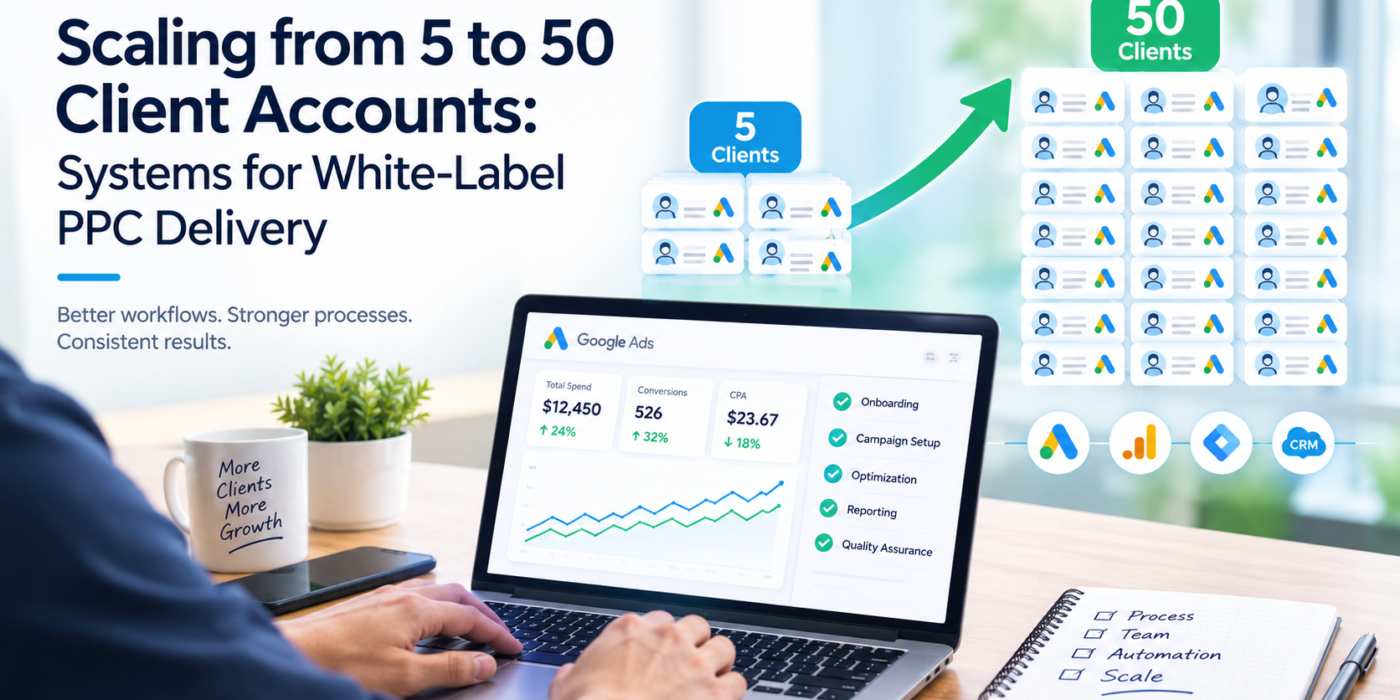
The illustrations used in this article are intended for editorial and educational purposes. Conceptual graphics should not be interpreted as actual client results, official advertising platform screenshots, or guarantees of campaign performance.