Google Local Services Ads vs. Search Ads for Home Services
Introduction
If you own or manage a home service business, you already know that generating consistent leads is essential to growth. Whether you provide plumbing, heating and cooling, electrical repairs, roofing, cleaning, pest control, or home improvement services, your potential customers frequently turn to Google when they need help.
Someone searching for “emergency plumber near me,” “AC repair in my area,” or “roof replacement estimate” may be ready to hire a contractor. Appearing prominently in those search results can put your business in front of customers at exactly the right moment.
Google offers several advertising options, but two of the most important for home service companies are Google Local Services Ads (LSAs) and standard Google Search Ads.
Although both can help businesses reach customers who are actively searching for services, they work differently. Local Services Ads focus on connecting local customers with eligible service providers, while standard Search Ads offer more control over keywords, ad messaging, landing pages, and the customer journey.
Choosing the right option can influence your advertising costs, lead quality, conversion rates, and overall return on investment.
In this guide, we’ll explain how both advertising platforms work, compare their costs and benefits, explore their limitations, and show you how to determine which approach is best for your home service business.
What Are Google Local Services Ads?

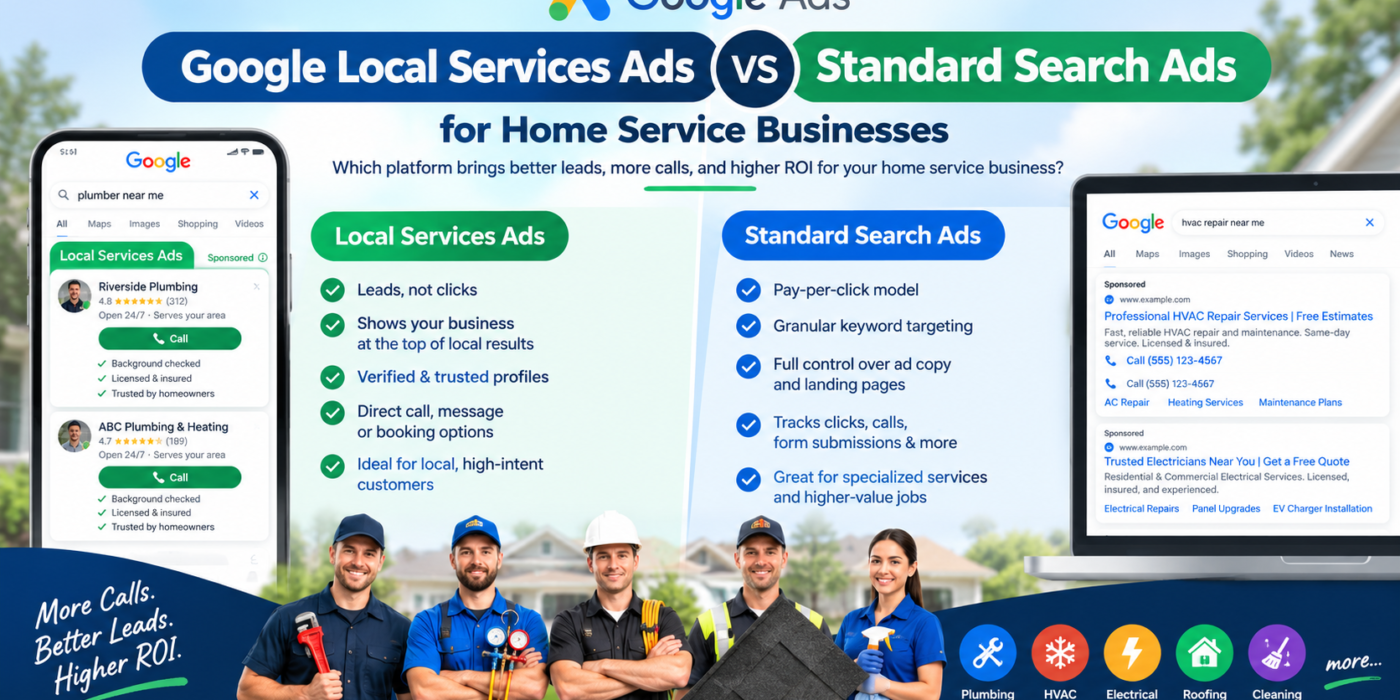
Google Local Services Ads are advertising placements designed to connect customers with eligible local service providers. They can appear prominently in Google Search results when people look for specific services in their area.
Depending on the market, service category, and current platform features, an LSA listing may display:
- Your business name and profile information
- Customer ratings and reviews
- Services offered
- Service areas
- Verification or screening information
- Options to call, message, or book your business
For example, if someone searches for “electrician near me,” eligible electrical contractors running Local Services Ads may appear near the top of the results.
This placement can help your business stand out before a potential customer reaches traditional website listings or standard paid search advertisements.
How do Local Services Ads work?
Local Services Ads follow a process that differs from conventional pay-per-click advertising.
1. Confirm your eligibility
Google Local Services Ads are not available for every business category or in every country. You must first confirm that your services and location are supported.
2. Create your business profile
Provide accurate business details, service categories, working hours, and the locations you serve.
3. Complete the required verification
Depending on your market and business category, Google may require business checks, license verification, insurance information, background checks, or other screening steps.
4. Set your budget and service preferences
Configure your advertising budget and select the services and areas that reflect what your business can actually handle.
5. Receive and manage leads
Potential customers may contact you through supported call, message, or booking options. Your team must respond promptly and record which leads become appointments and paying customers.
How are Local Services Ads charged?
The traditional Local Services Ads model is based on eligible leads rather than charging for every ad click.
This can be attractive to home service companies because the billing model is tied more directly to customer inquiries. However, a paid lead is not the same as a booked appointment or a profitable job.
Lead types, billing rules, dispute processes, and platform features can vary. Always check Google’s current requirements and policies for your market.
Benefits of Local Services Ads
1. Prominent local visibility
Local Services Ads are designed to reach people searching for nearby service providers. This can be especially valuable for businesses that depend on calls from customers in a defined service area.
2. A lead-focused pricing model
Because the traditional model charges for eligible leads, businesses can evaluate spending against incoming inquiries rather than clicks alone.
3. Trust signals
Customer reviews, ratings, and applicable Google verification badges can help potential customers assess your business. These signals may support trust, although they do not guarantee that every lead will convert.
4. Convenient customer contact
Customers may be able to contact your business directly without first visiting your website, reducing friction for people who need immediate help.
5. A useful option for urgent services
Plumbing emergencies, heating failures, air-conditioning repairs, and electrical problems often create high-intent searches. Local Services Ads can help eligible businesses reach those customers.
Limitations of Local Services Ads
Local Services Ads also have important drawbacks.
- Eligibility requirements: Your business category and location must qualify, and verification may be required.
- Less creative control: The format offers less control over ad copy and landing-page experiences than standard Search Ads.
- Variable lead quality: Some inquiries may be irrelevant, outside your service area, or unsuitable for your business.
- Limited customization: You generally have less granular keyword-level control than with standard Search campaigns.
- Operational demands: Missed calls, slow responses, and poor customer service can waste advertising spend even when the ads generate inquiries.
Local Services Ads can be a strong option for eligible businesses, but their performance still depends on your reputation, responsiveness, service coverage, and ability to convert leads into paying customers.
What Are Standard Google Search Ads?

Standard Google Search Ads are paid text advertisements that can appear when users search for terms related to your services. Advertisers create campaigns based on keywords, locations, bidding strategies, ad copy, and conversion goals.
Unlike Local Services Ads, standard Search Ads typically operate on a pay-per-click (PPC) model. You pay when someone clicks your advertisement, regardless of whether that person becomes a customer.
For example, an HVAC company could advertise for searches such as:
- Emergency AC repair
- Furnace installation
- Heat pump replacement
- HVAC maintenance services
- Commercial heating and cooling
- Air-conditioning installation near me
Each service can have its own campaign, ad groups, messaging, and landing page.
This structure gives advertisers considerable control over how they reach potential customers and what happens after someone clicks an ad.
How standard Search Ads work
1. Research keywords
Identify the search terms customers use when looking for your services. Prioritize terms that indicate a genuine need to hire a provider.
2. Create campaigns and ad groups
Organize campaigns around services, locations, or business objectives. An electrician, for example, might separate panel upgrades from EV charger installations.
3. Write relevant advertisements
Create headlines and descriptions that communicate your services, location, differentiators, and next step.
4. Choose targeting and bidding settings
Set geographic targeting, budget, bidding strategies, and other available campaign controls.
5. Send visitors to relevant pages
Direct users to service-specific landing pages where they can call, request an estimate, or book an appointment.
6. Measure and optimize performance
Use conversion tracking and campaign reports to identify profitable keywords, eliminate wasted spend, and improve lead quality.
Benefits of standard Search Ads
1. Greater keyword control
You can target specific search themes, including urgent repair services, premium installations, commercial projects, and location-based searches.
2. More control over advertising messages
You can test different headlines, offers, calls to action, and value propositions to discover what attracts qualified customers.
3. Customized landing pages
Instead of directing every visitor to your homepage, you can create dedicated pages for different services.
For example, someone searching for “water heater installation” can land on a page explaining installation options, pricing factors, warranties, and how to request an estimate.
4. Flexible campaign structure
You can allocate budgets across service categories, locations, and business priorities.
5. Detailed optimization opportunities
You can analyze search terms, click-through rates, conversion rates, location performance, and other metrics to improve campaign efficiency.
6. Support for different business objectives
Search Ads can generate phone calls and form submissions while also supporting quote requests, website engagement, and demand for specialized services.
Limitations of standard Search Ads
Standard Search Ads are flexible, but they require careful management.
- You can pay for clicks that never produce a lead.
- Competitive service keywords can be expensive.
- Poor keyword selection can attract irrelevant traffic.
- Weak landing pages can reduce conversion rates.
- Incorrect conversion tracking can make campaigns appear more successful or unsuccessful than they really are.
- Campaigns require ongoing monitoring and optimization.
The key is not simply to generate clicks. It is to attract the right potential customers and turn those visitors into profitable jobs.
Google Local Services Ads vs. Standard Search Ads: Key Differences
The following comparison highlights the main differences between the two advertising options.
| Feature | Local Services Ads | Standard Search Ads |
|---|---|---|
| Primary purpose | Generate local service leads | Generate clicks, calls, and website conversions |
| Typical pricing model | Pay per eligible lead under the traditional model | Usually pay per click |
| Placement | Prominent local service advertising placement | Sponsored search results |
| Eligibility | Supported categories and locations required | Broader availability, subject to Google Ads policies |
| Verification | Required screening or verification may apply | Standard account and advertising policy requirements |
| Keyword control | More limited | More granular |
| Ad copy control | Platform-defined profile format | Greater control over headlines, descriptions, and assets |
| Landing pages | Often focused on direct contact | Can direct visitors to customized landing pages |
| Customer contact | Supported direct calls, messages, or bookings | Calls, website visits, forms, and other conversion paths |
| Best suited to | Eligible local businesses seeking direct inquiries | Businesses needing control over targeting and customer journeys |
| Optimization | Lead quality, response, and booked jobs | Keywords, clicks, conversions, booked jobs, and revenue |
The most important distinction is that Local Services Ads emphasize direct local leads, while standard Search Ads provide greater control over how you target, persuade, and convert potential customers.
Neither option guarantees better leads or a higher return. Results depend on the market, competition, budget, service category, customer demand, and how well the business handles inquiries.
Which Advertising Platform Is Better for Different Home Service Businesses?
The best choice depends partly on the type of work you perform and how customers choose a contractor.
1. Plumbing companies

Plumbing businesses often receive inquiries from customers who need immediate assistance.
Examples include burst pipes, clogged drains, leaking fixtures, water-heater failures, and emergency repairs.
Why Local Services Ads may work well
- They can help eligible plumbers capture direct local inquiries.
- Customers can contact the business without navigating a complicated website.
- Reviews and applicable verification signals may support trust.
- The lead-based pricing model may be attractive when customers are ready to hire.
Why standard Search Ads may work well
- You can separate emergency plumbing from planned installation work.
- You can target searches for sewer repairs, water heaters, and specialized services.
- You can emphasize availability, service guarantees, or financing where appropriate.
- You can direct customers to pages relevant to their specific plumbing problem.
Recommendation: Eligible plumbing companies should consider testing LSAs for direct leads while using Search Ads for priority services and high-value jobs.
2. HVAC companies

Heating and cooling businesses can serve customers with very different needs. An emergency AC repair and a complete heat-pump installation have different levels of urgency, cost, and decision complexity.
Local Services Ads may help generate inquiries for eligible repair and maintenance services.
Standard Search Ads can be particularly useful for:
- AC installation and replacement
- Furnace replacement
- Heat pump installation
- Ductless mini-split systems
- Seasonal maintenance plans
- Commercial HVAC projects
For expensive replacement projects, a detailed landing page can explain equipment options, financing, warranties, and the estimate process.
Recommendation: Use the platform that produces the most profitable booked work for each service line. Consider combining both channels when the budget and tracking process allow a meaningful comparison.
3. Electrical contractors

Electrical businesses may offer troubleshooting, panel upgrades, lighting installation, EV charger installation, inspections, and other specialized work.
Local Services Ads can be useful for eligible contractors seeking local service inquiries.
Standard Search Ads offer flexibility for promoting specific projects, including EV charging equipment, panel upgrades, and larger installations.
Recommendation: Evaluate direct-lead performance through LSAs where available, and use Search Ads to target specialized, higher-value services with relevant landing pages. Advertisements should accurately represent licensing, qualifications, and the work your team can perform.
4. Roofing companies

Roofing projects can involve storm damage, roof leaks, inspections, repairs, and complete replacements. Many customers compare contractors before committing to a large project.
Standard Search Ads can help roofing businesses target specific searches and provide useful information through dedicated landing pages.
These pages might include:
- Roof replacement options
- Project galleries
- Warranty details
- Financing information
- Inspection and estimate requests
- Service-area information
If Local Services Ads are available for the business’s category and region, they can be evaluated alongside Search Ads.
Recommendation: Focus on qualified estimate requests, completed projects, and profit per acquired customer—not merely the number of inquiries.
5. Cleaning and other home services
Cleaning businesses, landscapers, pest-control providers, and other home service companies should assess both advertising formats against their specific goals.
LSAs may be attractive when available and when direct inquiries are the priority.
Standard Search Ads may be preferable when customers need to compare service packages, recurring plans, specialized treatments, or pricing options before contacting the business.
Recommendation: Choose based on local eligibility, customer search behavior, lead quality, and the economics of the service you sell.
How Much Do Local Services Ads and Search Ads Cost?
One of the biggest questions for home service businesses is whether Local Services Ads or standard Search Ads provide better value.
There is no universal answer because advertising costs vary by location, competition, service category, customer demand, and campaign quality.
Local Services Ads costs
Under the traditional LSA model, advertisers pay for eligible leads rather than each click.
Your actual cost depends on factors such as:
- Your service category and location
- Lead volume and demand
- Your configured budget
- Applicable billing and lead policies
A lead is not automatically a paying customer, so track the proportion of inquiries that become booked jobs.
Standard Search Ads costs
Standard Search Ads typically use a pay-per-click model.
Your costs depend on factors such as:
- Keyword competition
- Search demand
- Bidding strategy
- Ad relevance and quality
- Geographic targeting
- Budget and campaign settings
A click is only the beginning of the customer journey. You must account for the percentage of clicks that generate qualified leads and the percentage of leads that become customers.
Compare cost per booked job, not just cost per lead
Suppose two campaigns generate different lead volumes.
One campaign might produce fewer leads at a higher cost per lead but convert a greater percentage into paying customers. Another might produce many inexpensive inquiries that rarely turn into jobs.
The first campaign could be more profitable despite having a higher cost per lead.
Use these formulas:
- Cost per lead = Advertising spend ÷ Number of leads
- Cost per qualified lead = Advertising spend ÷ Number of qualified leads
- Cost per booked job = Advertising spend ÷ Number of booked jobs
- Customer acquisition cost = Attributable acquisition costs ÷ Number of new customers
- Return on ad spend (ROAS) = Attributed revenue ÷ Advertising spend
Where possible, also measure gross profit from acquired jobs. Revenue alone can be misleading when different services have different margins.
Illustrative Example: Which Channel Produces Better Results?
The following figures are hypothetical and are not industry benchmarks. They demonstrate why lead quality and conversion rates matter.
Assume a home service business invests $1,000 in each channel.
| Metric | Local Services Ads | Search Ads |
|---|---|---|
| Advertising spend | $1,000 | $1,000 |
| Leads generated | 25 | 40 |
| Booked jobs | 8 | 10 |
| Cost per lead | $40 | $25 |
| Cost per booked job | $125 | $100 |
In this example, Search Ads generate more leads at a lower cost per lead and a lower cost per booked job.
However, this doesn’t prove that Search Ads will always perform better. If the jobs generated by Local Services Ads have higher profit margins, lower cancellation rates, or greater repeat-business potential, the conclusion could change.
For a reliable comparison, track the revenue and profitability associated with leads from each channel.
How to Measure Advertising Performance Correctly
A successful Google Ads strategy requires more than checking how many calls or clicks an account generates.
You need to understand the complete journey from the first interaction to the completed job.
1. Define a qualified lead
Before comparing channels, establish what counts as a qualified lead.
For example, a qualified lead might be someone who:
- Needs a service your company actually offers
- Lives within your service area
- Has a realistic timeframe for the work
- Can be contacted successfully
- Is interested in a job that fits your business
Apply the same criteria to both channels so the comparison is fair.
2. Track phone calls and website forms
Monitor calls, form submissions, messages, and other available conversion actions.
Where appropriate, use call reporting or a suitable call-tracking system. Configure conversion tracking carefully and account for duplicate inquiries and spam.
A phone call should not automatically count as a qualified lead simply because it lasted a few seconds.
3. Connect leads to booked jobs
Use a CRM or a consistent lead-tracking spreadsheet to record:
- Lead source
- Service requested
- Customer location
- Contact date
- Lead qualification status
- Appointment or estimate status
- Job value
- Final outcome
This allows you to see which advertising channel brings customers who actually hire your company.
4. Measure response time
Home service customers often contact several contractors before making a decision.
Monitor missed calls, time to first response, message response times, and appointment availability.
Even an excellent advertising campaign can underperform if the business does not answer the phone or follow up promptly.
5. Review performance at the right intervals
Weekly reviews can help identify wasted spend, irrelevant search terms, missed calls, and technical problems.
Monthly reviews can provide a better view of booked jobs and revenue. Businesses with longer sales cycles may need additional time before drawing conclusions.
Should You Run Local Services Ads and Search Ads Together?
For many eligible home service businesses, running both channels can be a sensible strategy.
They can serve complementary purposes instead of being treated as mutually exclusive alternatives.

A practical combined strategy
Use Local Services Ads for direct local leads.
Where eligible, use LSAs to capture customers who want to contact a nearby service provider.
Use Search Ads for priority services.
Create dedicated campaigns for services that deserve more control over targeting, messaging, or the customer journey.
Separate your reporting.
Track spend, qualified leads, booked jobs, and revenue separately for each channel.
Avoid making decisions based on lead volume alone.
A channel that produces more inquiries may not produce more profitable work.
Scale according to business capacity.
Before increasing budgets, ensure your team can answer additional calls, schedule appointments, and deliver the work.
What if your budget is limited?
If your budget cannot support both channels meaningfully, start with the option that best matches your immediate goal.
- If you are eligible for LSAs and need direct local inquiries, consider testing LSAs first.
- If you need granular keyword targeting, service-specific campaigns, or customized landing pages, Search Ads may be the more practical starting point.
- If your category or location is not eligible for LSAs, standard Search Ads may be the available alternative.
Avoid spreading a small budget across too many campaigns before you have enough data to determine what works.
Common Mistakes Home Service Businesses Should Avoid
Even a well-funded campaign can waste money if the fundamentals are neglected.
1. Choosing the cheapest lead instead of the best lead
A low-cost inquiry has little value if the customer cannot be served or never books a job.
Compare qualified leads and booked jobs instead.
2. Targeting areas you cannot serve profitably
Advertising outside your actual service coverage can generate irrelevant calls, long travel times, and unprofitable jobs.
Set service areas according to operational capacity and travel costs.
3. Ignoring search-term quality
Standard Search Ads can attract irrelevant traffic if keywords and negative keywords are not managed properly.
Review search terms regularly and refine targeting to focus on relevant services and customer intent.
4. Sending every visitor to the homepage
A customer searching for furnace installation should not have to navigate a generic homepage to find relevant information.
Use service-specific landing pages with clear calls to action.
5. Failing to track lead outcomes
Without information about appointments, estimates, and completed jobs, you cannot reliably compare advertising performance.
6. Ignoring missed calls
Lead generation and lead management must work together. Establish a process for answering calls, returning missed calls, and following up on messages.
7. Increasing budgets too early
Do not scale merely because impressions, clicks, or calls have increased. Confirm that the campaign is producing qualified leads at an acceptable cost.
8. Assuming that verification guarantees sales
Verification badges and customer reviews may help establish trust, but they do not guarantee that a customer will hire your company.
Your responsiveness, reputation, pricing, availability, and service quality still matter.
A Practical 30-Day Testing Plan
Use this initial plan to compare advertising performance without making premature decisions.
1 Days 1–5: Prepare
Confirm LSA eligibility and verification requirements. Review your service areas, business profile, customer reviews, landing pages, call handling, and conversion tracking.
2 Days 6–10: Launch or refine
Start with a clearly defined campaign structure and a budget you can afford to test. Keep channel reporting separate.
3 Days 11–20: Monitor quality
Review search terms, missed calls, irrelevant leads, response times, and booking outcomes. Correct tracking and targeting problems.
4 Days 21–30: Evaluate
Compare qualified lead costs, booked-job costs, close rates, average job value, and estimated profit. Decide what to improve, scale, or pause.
A 30-day review is a starting point, not a guarantee of statistically reliable results. Low lead volume, seasonal changes, verification delays, and longer sales cycles may require a longer evaluation period.
Frequently Asked Questions
1. Are Google Local Services Ads better than standard Search Ads?
Neither option is universally better. Local Services Ads are designed for eligible businesses seeking direct local leads, while standard Search Ads offer more control over keywords, advertising messages, and landing pages. Compare their performance using qualified leads, booked jobs, and profitability.
2. Do Local Services Ads charge for clicks?
The traditional Local Services Ads model charges for eligible leads rather than every click. Billing rules and features may vary, so check Google’s current policies for your business category and location.
3. Can a small home service business use both advertising platforms?
Yes. A small business can use both if they are available and the budget supports meaningful testing. It is also reasonable to start with one channel, establish reliable tracking, and introduce the second when resources allow.
4. Do I need a website to use Local Services Ads?
Requirements vary by market and business category. Even where direct contact is available, a professional website can support customer trust, explain your services, and help convert visitors from other marketing channels. Check the current onboarding requirements that apply to your business.
5. How much should a home service business spend on Google Ads?
There is no universal budget that works for every business. Your budget should reflect local competition, expected lead costs, service profitability, available staff, and the number of jobs you can handle. Begin with an affordable test budget and increase spending when performance supports it.
6. Which platform is better for emergency plumbing and HVAC repairs?
Local Services Ads may be effective for eligible businesses seeking direct calls from local customers. Standard Search Ads can also target urgent service keywords and provide additional control over messaging and targeting. Compare the cost and quality of booked emergency jobs in your market.
7. How long should I test each platform?
A 30-day review is a useful starting point, but you may need longer to generate enough qualified leads and observe completed jobs. Do not make a major budget decision based on a small number of inquiries.
8. What is the most important metric to track?
For most home service businesses, cost per booked job is more useful than cost per click or cost per lead alone. Ideally, measure customer acquisition cost and the profit generated by acquired jobs as well.
Conclusion
Google Local Services Ads and standard Search Ads can both help home service businesses connect with customers who are actively searching for solutions.
However, they serve different purposes.
Local Services Ads are worth considering when your business is eligible, you want direct local inquiries, and you prefer the traditional lead-based billing model.
Standard Search Ads are valuable when you need greater control over keyword targeting, ad messaging, service-specific campaigns, and landing pages.
For many established home service businesses, a combination of both may deliver the best results. LSAs can capture direct inquiries, while Search Ads can target specialized services and guide customers through a more customized journey.
Ultimately, the best advertising strategy is not necessarily the one that generates the most clicks or the cheapest leads. It is the one that consistently brings in qualified customers, converts them into profitable jobs, and supports sustainable business growth.
Measure performance carefully, improve your lead-handling process, and allocate your advertising budget according to actual business outcomes rather than assumptions.
Sources and Further Reading
Use these official Google resources to verify current platform features, eligibility, and requirements before implementing the recommendations in this article.
- Google Local Services Ads: Official Local Services Ads overview
- Google Local Services Help: Getting started with Local Services Ads
- Google Ads Help: Google Ads campaign setup, measurement, and optimization guidance
Image Disclaimer: Images used in this article are for illustrative and informational purposes only. They may include AI-generated visuals or representative mockups and may not depict actual businesses, services, or Google Ads interfaces. Google and its logos are trademarks of Google LLC. All trademarks belong to their respective owners. Images do not imply endorsement or affiliation with Google.
Editorial note: Advertising availability, terminology, verification requirements, billing rules, and campaign interfaces can change. Confirm the current guidance for your country, service category, and account before publishing operational claims.