Google Search Ads vs Performance Max: Which Is Better for Lead Generation in 2026?
Generating high-quality leads is one of the biggest challenges businesses face when investing in Google Ads. Whether you run a local service business, B2B company, digital marketing agency, healthcare practice, or professional service firm, choosing the right campaign type can significantly influence your advertising results.
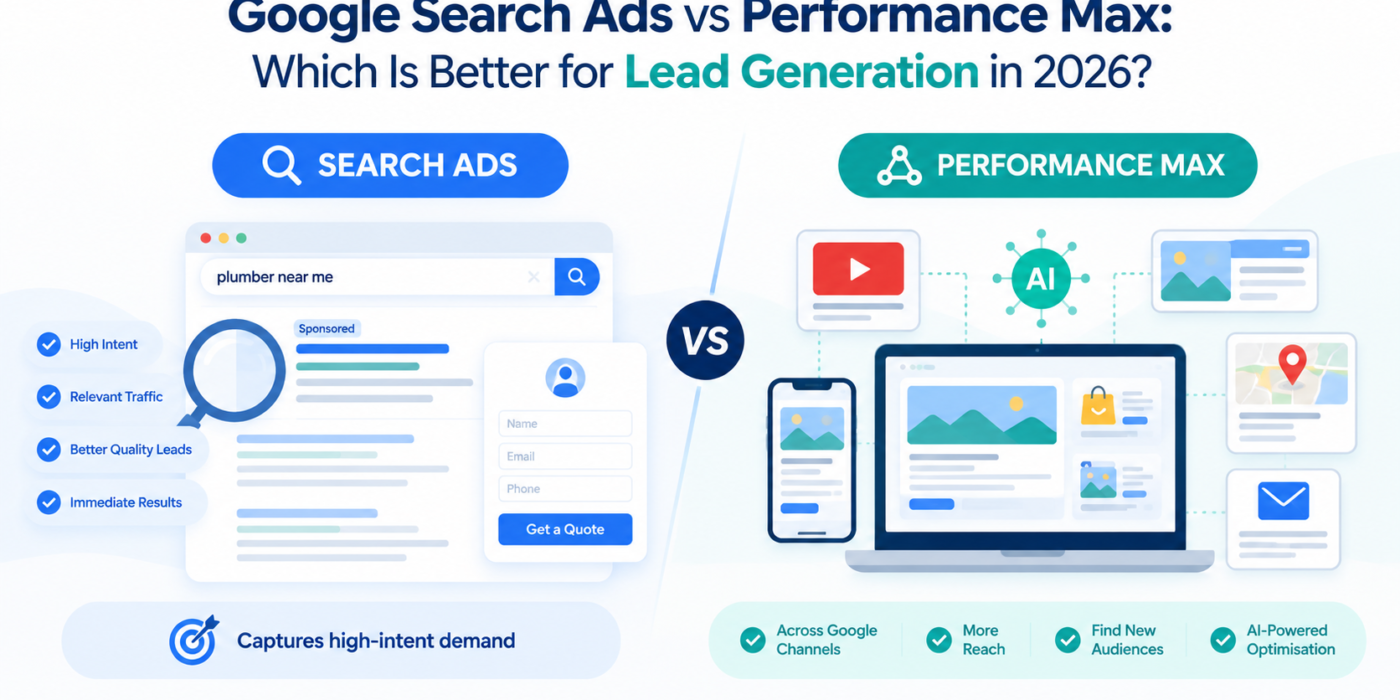
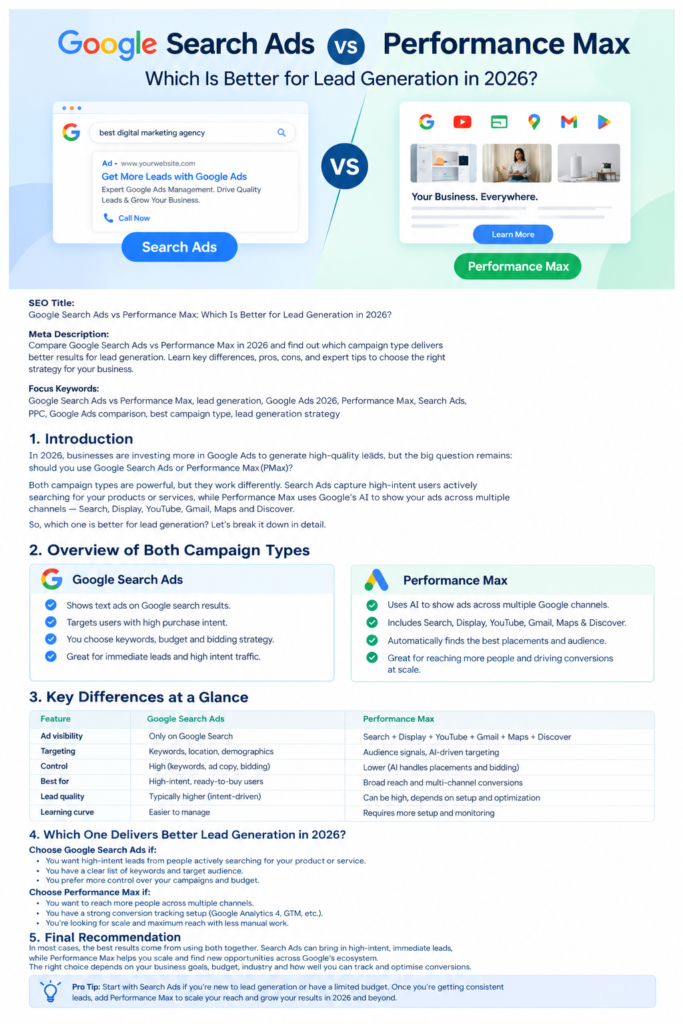
Two popular options for lead generation are Google Search Ads and Performance Max. Both use Google’s advertising platform, but they approach targeting, audience reach, and conversion optimization differently.
Google Search Ads vs Performance Max: Which is better for lead generation in 2026?
The short answer is that Search campaigns are often the best starting point for businesses targeting people actively searching for their services. Performance Max can help expand reach across Google’s advertising channels when reliable conversion tracking, suitable creative assets, and sufficient data are available.
For many businesses, the strongest strategy is to use both campaign types with clear objectives and measure their contribution to qualified leads and actual sales.
In this guide, we’ll compare Google Search Ads and Performance Max, explain their advantages and disadvantages, and show you how to choose the right approach for your lead generation strategy.
1. What Are Google Search Ads?
Google Search Ads are paid text advertisements that appear on Google search results when users search for relevant products or services.
For example, someone searching for “Google Ads management services,” “emergency plumber near me,” or “commercial cleaning company” may see relevant sponsored results.
These searches often indicate that the user is actively researching a solution or looking for a service provider.
How Google Search Ads Work
Search campaigns allow advertisers to build campaigns around relevant keywords, create ad copy, select landing pages, and use bidding strategies to pursue their marketing objectives.
Key elements include:
- Keyword targeting to reach relevant search queries.
- Responsive search ads with multiple headlines and descriptions.
- Location targeting to focus on selected cities, regions, or countries.
- Negative keywords to reduce irrelevant traffic.
- Ad assets such as call, sitelink, and lead form assets where eligible.
- Conversion tracking to measure calls, form submissions, bookings, and other valuable actions.
- Smart Bidding strategies to optimize bids using conversion-related signals.
Search campaigns can be configured with different match types and automated targeting features. Therefore, keyword targeting provides useful direction, but it does not always mean that every impression will match a single exact search phrase.
Advantages of Google Search Ads for Lead Generation
1. Reach people with active intent
Search campaigns can connect your business with users who are already looking for the services you offer. This makes them particularly useful for capturing existing demand.
2. Greater control over keyword strategy
Advertisers can organize campaigns around services, locations, product categories, and commercial search intent. Negative keywords help filter out irrelevant queries.
3. More control over ad messaging
You can tailor ad headlines and descriptions to particular services, customer problems, pricing advantages, and calls to action.
4. Clearer campaign structure
Separate campaigns or ad groups can help you analyze performance across service categories, locations, and search themes.
5. Useful for local and B2B lead generation
Search Ads can work well for plumbers, electricians, dentists, consultants, SaaS companies, marketing agencies, training providers, and other businesses that rely on inquiries.
Disadvantages of Google Search Ads
Search campaigns also have limitations:
- Competitive keywords can be expensive.
- Search volume may be limited in smaller markets or specialized industries.
- Broad or poorly managed targeting can generate irrelevant clicks.
- Performance depends on the quality of ads, landing pages, and conversion tracking.
- Search campaigns mainly capture existing demand rather than consistently introducing a business to entirely new audiences.
Best suited for: Businesses that want to capture high-intent searches and generate leads from people actively looking for a solution.
2. What Is Performance Max?
Performance Max, commonly called PMax, is a goal-based Google Ads campaign type that uses Google’s AI to optimize advertising across multiple Google channels from a single campaign.
Depending on eligibility, settings, and available inventory, these channels include:
- Google Search
- YouTube
- Google Display Network
- Discover
- Gmail
- Google Maps
Instead of relying primarily on a keyword-focused campaign structure, Performance Max uses conversion goals, bidding strategies, audience signals, creative assets, and other available data to identify opportunities across Google’s advertising inventory.
It is designed to complement traditional Search campaigns and help advertisers discover additional conversion opportunities.
How Performance Max Works
Advertisers provide campaign assets and business information, including headlines, descriptions, images, logos, videos, landing pages, audience signals, and conversion goals.
Google’s AI uses these inputs to automate bidding, choose eligible placements, combine creative assets, and allocate budget toward opportunities it predicts will support the campaign’s objectives.
For lead generation, the quality of these inputs is especially important. If a campaign is optimized for the wrong conversion action, it may generate inexpensive but low-quality leads.
Advantages of Performance Max for Lead Generation
1. Reach across multiple channels
Performance Max can reach potential customers through different Google properties, not only traditional search results.
2. Automated bidding and budget allocation
Google’s AI adjusts bids and distributes campaign spend across eligible opportunities based on predicted performance and campaign objectives.
3. Opportunities beyond active search demand
Visual advertisements and other eligible placements can introduce your business to users who may not currently be searching for your services.
4. Multiple creative formats
Advertisers can supply text, images, logos, and videos to support different ad formats and placements.
5. Potential to scale lead generation
Once conversion tracking and lead-quality measurement are reliable, Performance Max can help businesses explore additional audiences and conversion opportunities.
Disadvantages of Performance Max
Performance Max is not automatically the best option for every advertiser.
Common challenges include:
- Less direct control over individual placements and targeting decisions than a tightly managed Search strategy.
- Greater reliance on accurate conversion tracking and useful first-party data.
- The need for strong creative assets across multiple formats.
- Potential for low-quality leads if the campaign optimizes toward weak conversion signals.
- More difficulty diagnosing performance when advertisers evaluate only total lead volume instead of qualified leads and sales.
- A learning period during which results may fluctuate.
Performance Max provides search-term insights and other reporting tools, but the level of control and reporting differs from traditional Search campaigns.
Best suited for: Businesses with dependable conversion measurement, suitable creative assets, and a need to expand beyond keyword-based search traffic.
3. Google Search Ads vs Performance Max: Key Differences
The following table summarizes the main differences for lead generation.
| Feature | Google Search Ads | Performance Max |
|---|---|---|
| Primary approach | Capture relevant search demand | Optimize across multiple Google channels |
| Reach | Primarily Google Search | Search, YouTube, Display, Discover, Gmail, Maps and other eligible inventory |
| Targeting | Keywords, match types, locations and other settings | AI-driven targeting, audience signals and campaign controls |
| Creative formats | Primarily text ads, with eligible assets | Text, images, logos, videos and other supported assets |
| Control | More direct keyword and ad-group control | More automated targeting, bidding and placement decisions |
| Lead quality | Can benefit from strong search intent | Depends heavily on conversion signals and optimization |
| Reporting | Search terms, keywords, ads and other Search reports | Campaign insights, asset reporting and search-term insights |
| Creative requirements | Text ads and relevant landing pages | Multiple suitable creative assets are generally beneficial |
| Best starting point | Capturing high-intent leads | Expanding reach when measurement and assets are ready |
| Main challenge | Competition and limited search demand | Reliance on automation and accurate data |
Neither campaign type guarantees better results. Performance depends on your industry, competition, budget, conversion data, landing page experience, and the quality of your leads.
4. Which Campaign Type Generates Better-Quality Leads?
For many service businesses, Google Search Ads are a practical starting point because they can target people actively searching for a specific service.
Consider these examples:
- “Google Ads agency for ecommerce”
- “commercial HVAC repair company”
- “B2B lead generation services”
- “dentist accepting new patients”
- “industrial electrical technician training”
These searches may signal a specific need, although the intent of individual users will vary.
Search campaigns allow advertisers to build focused keyword strategies and align their advertisements with those needs.
Performance Max can generate valuable leads as well. Its advantage is the ability to identify conversion opportunities across a wider range of Google channels.
However, broader reach does not automatically mean better lead quality. A campaign may generate more form submissions without producing more qualified prospects or paying customers.
How to Measure Lead Quality
Do not evaluate either campaign type using cost per lead alone.
Track metrics such as:
- Total leads generated
- Qualified leads
- Cost per qualified lead
- Lead-to-opportunity conversion rate
- Sales conversion rate
- Customer acquisition cost
- Revenue generated
- Return on advertising spend, where applicable
For example, imagine two campaigns produce the following hypothetical results.
Campaign A — Search Ads
- Advertising spend: $2,000
- Leads generated: 40
- Qualified leads: 20
- Cost per lead: $50
- Cost per qualified lead: $100
Campaign B — Performance Max
- Advertising spend: $2,000
- Leads generated: 60
- Qualified leads: 12
- Cost per lead: approximately $33.33
- Cost per qualified lead: approximately $166.67
In this example, Performance Max generates more leads at a lower cost per lead, but Search Ads generate more qualified leads and a lower cost per qualified lead.
These are illustrative figures, not industry benchmarks. The lesson is that campaign success should be judged by business outcomes rather than lead volume alone.
5. Which Is Better for Different Types of Businesses?
The right campaign type depends on how customers discover your services and how your business converts inquiries into revenue.
Local Service Businesses
Examples include plumbers, electricians, HVAC contractors, cleaning companies, roofers, and repair services.
Recommended starting point: Google Search Ads.
These businesses often benefit from reaching people searching for a service in a specific location. Focus on service-specific keywords, location targeting, relevant landing pages, call tracking, and lead qualification.
Performance Max may be worth testing when the business has reliable conversion data and wants to expand its reach.
B2B Companies
B2B companies often have longer sales cycles and more complex buying decisions.
Recommended starting point: Google Search Ads.
Prioritize commercial-intent keywords, relevant service pages, clear value propositions, and lead forms that collect useful qualification information.
Performance Max may complement Search once the advertiser can measure qualified leads, opportunities, or closed deals rather than only initial form submissions.
SaaS Companies
Software businesses may target searches such as product comparisons, solution-specific terms, and software category keywords.
Recommended approach: Search first, then test Performance Max where appropriate.
Measure demo requests, qualified trials, sales opportunities, and paid subscriptions. A high volume of free sign-ups does not necessarily indicate strong customer acquisition performance.
Healthcare and Professional Services
Clinics, dentists, consultants, legal professionals, and other service providers often need a reliable flow of relevant inquiries.
Recommended starting point: Google Search Ads.
Build campaigns around specific services and locations. Use accurate conversion tracking, appropriate messaging, and landing pages that clearly explain the service and next steps.
Any campaign should comply with Google’s applicable advertising policies and privacy requirements.
Ecommerce Businesses
Ecommerce advertisers have different objectives from many lead generation businesses.
Recommended approach: Consider Performance Max alongside relevant Search campaigns.
Product feeds, purchase-value tracking, and accurate revenue measurement can help Performance Max optimize toward online sales. Search campaigns can support specific product categories, brand searches, and high-intent queries.
6. Is Performance Max Better for Businesses With Small Budgets?
Not necessarily.
A smaller advertising budget makes it particularly important to understand which queries, services, and customer segments generate valuable leads.
For many smaller lead generation businesses, a focused Search campaign is a sensible starting point because it provides a clearer structure for testing service-specific keywords, ads, landing pages, and lead quality.
However, there is no universal budget threshold at which Performance Max becomes the better option.
A small business may benefit from Performance Max if it has suitable creative assets, trustworthy conversion tracking, sufficient conversion signals, and a business model that can benefit from cross-channel reach.
Likewise, a business with a large budget may still achieve better results by prioritizing Search if its customers primarily convert through high-intent searches.
How to Allocate Your Budget
If your budget is limited:
- Identify the services or products with the highest business value.
- Start with relevant, high-intent search themes.
- Track qualified leads and actual sales.
- Remove irrelevant traffic and improve landing pages.
- Test Performance Max when your measurement and campaign structure are ready.
Avoid splitting a small budget across multiple campaigns simply because more campaign types are available.
7. Can You Run Search Ads and Performance Max Together?
Yes. Running both campaign types can be an effective strategy when each has a clear role.
Search campaigns can focus on capturing high-intent demand, while Performance Max can explore additional conversion opportunities across Google’s advertising channels.
The objective is not simply to run more campaigns. It is to improve total business results.
Recommended Campaign Structure
Campaign 1: Search — High-Intent Leads
Target relevant service and commercial-intent keywords. Use focused ad groups or campaign structures, appropriate negative keywords, and dedicated landing pages.
Campaign 2: Search — Brand or Specialized Services
Where appropriate, separate brand searches or important service categories to maintain clear reporting and budgeting.
Campaign 3: Performance Max — Additional Reach
Test Performance Max when accurate conversion tracking and suitable creative assets are available. Optimize toward qualified leads or another meaningful business outcome.
This structure should be adapted to your budget, account size, conversion volume, and business objectives.
Important: Avoid Misreading Campaign Overlap
Search and Performance Max can have overlapping eligibility, but Google uses prioritization rules to determine which eligible ad serves in an auction.
For example, eligible Search keywords with an identical exact-match query are prioritized over Performance Max in the circumstances described in Google’s campaign guidance.
Do not assume that running both campaigns automatically means they will compete against each other or that every Performance Max conversion is incremental.
Evaluate total account performance, lead quality, search-term insights, and changes in overall results before deciding whether the additional campaign is creating genuine growth.
8. How to Optimize Google Search Ads for Better Lead Generation
Choosing the right campaign type is only one part of the process. Campaign optimization and conversion tracking are equally important.
1. Focus on Commercial-Intent Keywords
Prioritize searches that indicate a genuine need for your service.
For example, a business offering PPC management may prioritize terms related to Google Ads management services, PPC management companies, or Google Ads consultants.
Review actual search terms regularly and exclude irrelevant queries where appropriate.
2. Improve Responsive Search Ads
Write relevant headlines and descriptions that address the user’s needs.
Highlight your service, value proposition, relevant experience, and next step. Use clear calls to action such as “Request a Quote,” “Book a Consultation,” or “Get a Free Audit” when those offers are genuinely available.
3. Improve Landing Page Relevance
Your landing page should match the service and promise presented in your ad.
Include a clear headline, concise benefits, trust signals, relevant case studies where available, and a prominent conversion action.
Reduce unnecessary form fields and ensure the page works well on mobile devices.
4. Use Smart Bidding Carefully
Conversion-based bidding strategies can help optimize toward valuable actions when conversion tracking is accurate.
Choose bidding targets that reflect realistic business economics. An overly restrictive target may limit campaign delivery.
5. Review Lead Quality
Work with your sales team to identify which keywords, campaigns, and locations generate qualified opportunities.
Where supported, use CRM data and offline conversion imports to help Google Ads understand which leads progress toward a sale.
9. How to Optimize Performance Max for Lead Generation
Performance Max relies heavily on the quality of the data, creative assets, and objectives provided to it.
1. Set Up Accurate Conversion Tracking
Track meaningful actions, including:
- Valid lead form submissions
- Qualified leads
- Appointment bookings
- Sales opportunities
- Closed deals, where measurement supports them
Avoid optimizing primarily for low-value actions such as page views or button clicks when your actual objective is qualified lead generation.
2. Provide Strong Creative Assets
Supply relevant headlines, descriptions, images, logos, and videos where applicable.
Create assets that communicate your services clearly and suit the different placements in which your ads may appear.
3. Use Audience Signals Thoughtfully
Provide useful first-party audience data and audience signals where appropriate. These help guide the system but should not be mistaken for strict audience targeting in every circumstance.
4. Review Search-Term Insights and Placements
Check available search-term insights, asset reports, and placement reporting to identify potential problems.
Use negative keywords, placement exclusions, brand controls, and other available settings where appropriate. Review final URL expansion if your campaign sends users to pages that are not relevant to the campaign objective.
5. Optimize for Qualified Leads
If the campaign receives many unqualified inquiries, improve lead forms, add appropriate qualifying questions, and review your conversion goals.
Where sufficient data is available, optimize toward qualified leads or converted leads rather than treating every initial submission as equally valuable.
6. Allow Time for Learning
Avoid making frequent, substantial changes immediately after launch. Google recommends allowing time for the campaign to learn, with the required period depending on its complexity and conversion volume.
Evaluate performance using sufficient data and account for your normal sales cycle before making major decisions.
10. Common Mistakes to Avoid in 2026
Whether you use Search Ads, Performance Max, or both, avoid these common mistakes.
Mistake 1: Optimizing for the cheapest lead
A low cost per lead is not useful if most inquiries are irrelevant or cannot become customers.
Mistake 2: Launching Performance Max without proper tracking
Automated bidding needs reliable signals. Incorrect or incomplete conversion tracking can undermine campaign performance.
Mistake 3: Using the same landing page for every service
A visitor searching for a particular service should reach a page that directly addresses that need.
Mistake 4: Ignoring search terms
Review Search campaign search terms and the insights available in Performance Max. Use those findings to refine targeting and identify wasted spend.
Mistake 5: Making major changes too frequently
Constantly changing budgets, targets, and assets can make it harder to assess performance and may disrupt the learning process.
Mistake 6: Judging campaigns only by platform-reported conversions
Connect advertising data with CRM records, qualified opportunities, and sales wherever possible. This provides a more complete view of campaign profitability.
Mistake 7: Assuming more reach always means more incremental leads
Measure whether Performance Max adds valuable leads beyond those already generated by your other campaigns. Consider the total account results rather than isolated metrics.
11. How to Choose the Right Campaign Type: A Practical Framework
Use the following framework to guide your decision.
Choose Google Search Ads First If:
- Your customers actively search for your services.
- You need more control over keyword targeting and ad messaging.
- Your budget requires a focused testing strategy.
- You want to identify which search queries generate qualified leads.
- You have limited creative assets for cross-channel advertising.
Consider Performance Max If:
- Your conversion tracking is accurate and reliable.
- You have suitable images, videos, and text assets.
- You want to reach potential customers across multiple Google channels.
- You can evaluate qualified leads and business outcomes.
- Your account has enough useful conversion data to support meaningful optimization.
Consider Using Both If:
- Search campaigns already generate consistent, qualified leads.
- You want to explore additional demand and audience opportunities.
- You have sufficient budget to test without undermining your core campaigns.
- You can measure the incremental business value of additional advertising.
The best choice depends on the business model, sales cycle, advertising budget, conversion volume, and available measurement.
12. Final Verdict: Google Search Ads vs Performance Max in 2026
So, which is better for lead generation in 2026?
For many service-based businesses, Google Search Ads are the more practical starting point because they capture active search demand and offer greater direct control over keywords and ad messaging.
Performance Max is a valuable option for businesses that want to expand across Google’s advertising channels and can provide reliable conversion data, relevant creative assets, and clear business objectives.
However, neither campaign type is universally superior.
Our recommendation: Start with a well-structured Search strategy when high-intent demand is available. Establish accurate conversion tracking, improve landing pages, and measure qualified leads. Once performance is consistent, test Performance Max to determine whether it can generate additional valuable leads at an acceptable cost.
Ultimately, the goal is not to generate the largest number of conversions. It is to generate the right leads, acquire customers profitably, and build a sustainable advertising strategy.
Frequently Asked Questions (FAQs)
1. Is Google Search Ads better than Performance Max for lead generation?
Google Search Ads are often a strong starting point for businesses targeting people actively searching for their services. Performance Max may be more useful when a business wants to expand across multiple Google channels and has reliable conversion tracking. The best choice depends on the business and its objectives.
2. Can Performance Max generate high-quality leads?
Yes. Performance Max can generate high-quality leads when it has accurate conversion tracking, appropriate bidding goals, strong creative assets, and useful data about lead quality. Advertisers should evaluate qualified leads and sales, not just form submissions.
3. Should small businesses use Performance Max?
Small businesses can use Performance Max, but it is not automatically the best starting point. A focused Search campaign may be easier to evaluate when budgets are limited and customers actively search for the services offered.
4. Can Search Ads and Performance Max run at the same time?
Yes. They can complement each other. Search can capture high-intent demand while Performance Max explores opportunities across other Google channels. Monitor overall account performance and use the available controls to manage overlap.
5. Which campaign type has a lower cost per lead?
Neither campaign type consistently guarantees a lower cost per lead. Results depend on competition, audience demand, campaign setup, landing page quality, conversion tracking, and bidding strategy.
6. Does Performance Max replace Google Search Ads?
No. Performance Max can complement Search campaigns, but traditional Search remains useful for advertisers who need direct keyword management and a focused approach to search demand.
7. How long should you test Performance Max?
Allow sufficient time for learning and meaningful measurement. Google’s guidance indicates that some campaigns may need at least one to two weeks, while more complex setups or campaigns with limited conversion volume can require longer. Also consider the time needed for leads to qualify and convert into customers.
8. What is the most important metric for lead generation?
Cost per qualified lead is often more useful than cost per raw lead. For businesses with longer sales cycles, customer acquisition cost, conversion rate from lead to sale, and revenue or profit generated can be even more informative.
9. Should Performance Max optimize for form submissions or qualified leads?
Whenever reliable data and sufficient conversion volume are available, optimizing toward qualified leads or a later, more valuable stage of the sales process can better align advertising with business outcomes. The appropriate conversion goal depends on the account’s data and sales cycle.
10. What is the best Google Ads strategy for lead generation in 2026?
For many service businesses, a sensible approach is to start with focused Search campaigns, establish reliable conversion measurement, optimize toward lead quality, and then test Performance Max when additional reach can be evaluated meaningfully.
Final Takeaway
Google Search Ads and Performance Max serve different roles in a successful Google Ads strategy. Search helps businesses capture existing demand, while Performance Max can expand reach and uncover additional conversion opportunities.
The best results come from choosing campaigns based on business objectives, tracking the right conversions, and continuously improving lead quality.
If your Google Ads campaigns are generating clicks but not enough qualified leads, review your targeting, conversion tracking, landing pages, and bidding strategy before increasing your budget.
About the Author
Fahad Zahid is a Google Ads and PPC specialist who helps businesses improve campaign performance through strategic campaign management, conversion tracking, keyword research, and landing page optimization.
Learn more about Google Ads management and PPC services at https://fahadzahid.com/.