White-Label Google Ads Reporting: Agency Guide
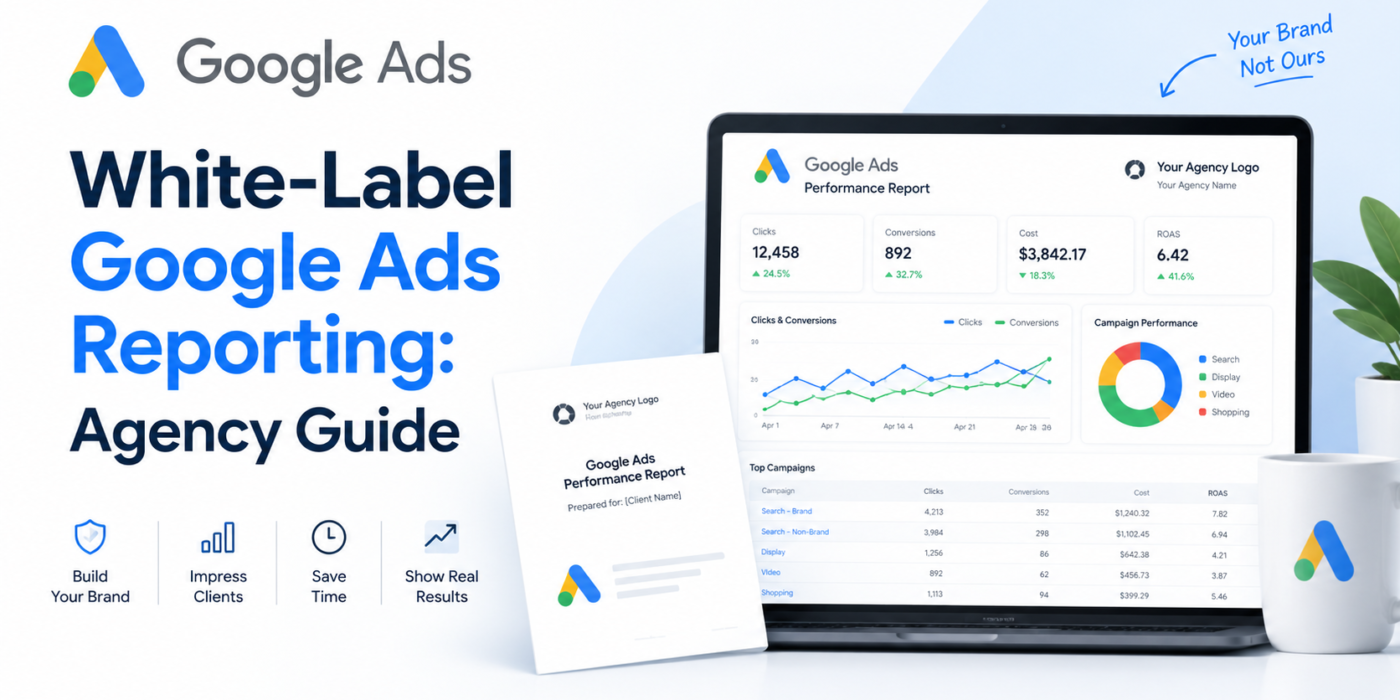
White-Label Google Ads Reporting: What Agencies Should Expect from a PPC Partner
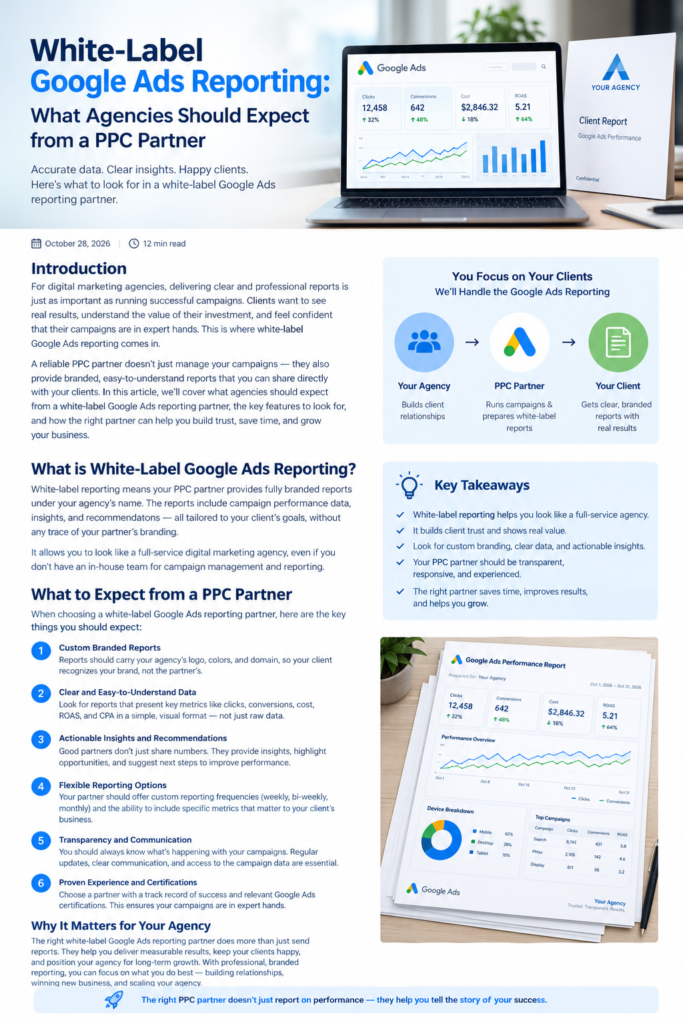
Introduction
For digital marketing agencies, delivering clear and professional reports is just as important as running successful advertising campaigns. Clients want to understand what their advertising investment is achieving, where results are improving, and what actions are being taken to improve performance.
When agencies outsource some or all of their pay-per-click (PPC) services, reporting becomes an essential part of the partnership. A reliable reporting process helps agencies demonstrate value, maintain client confidence, and make better-informed marketing decisions.
This is where white-label Google Ads reporting becomes valuable.
A white-label PPC partner can prepare branded performance reports, analyse campaign results, identify opportunities, and provide recommendations that your agency can share with clients under its own brand.
However, not all reporting partners offer the same level of service. Some simply provide dashboards with campaign metrics, while others deliver meaningful analysis and actionable insights.
In this guide, we explain what agencies should expect from a white-label Google Ads reporting partner, which metrics matter most, what questions to ask before choosing a provider, and how to build a successful long-term partnership.
What Is White-Label Google Ads Reporting?
White-label Google Ads reporting is a service in which a PPC specialist or service provider prepares campaign performance reports that another agency can present under its own branding.
The reports may include the agency’s logo, brand colours, preferred terminology, client-specific KPIs, and customised presentation formats.
Behind the scenes, the white-label partner may handle tasks such as collecting campaign data, validating metrics, analysing performance, preparing written summaries, and recommending next steps.
The agency then shares the reports with its clients as part of its own service.
For example, a digital marketing agency managing multiple clients may partner with a PPC specialist to prepare monthly Google Ads reports. Instead of spending hours manually compiling performance data, the agency receives a professional, client-ready report that fits its existing brand.
White-label reporting can be offered as a standalone service or as part of a broader white-label PPC management arrangement.
The key difference: Good white-label reporting does more than display numbers. It helps clients understand what those numbers mean for their business.
Why Do Agencies Need a White-Label PPC Reporting Partner?
As agencies grow, managing reporting for multiple advertising accounts can become time-consuming. Each client may have different objectives, reporting requirements, conversion actions, and expectations.
A specialist reporting partner can help agencies manage this workload more efficiently.
1. Save Time and Reduce Manual Work
Preparing reports manually can involve exporting data, checking calculations, creating charts, writing summaries, and formatting documents.
A consistent reporting process reduces repetitive tasks and allows account managers to focus on strategy, client communication, and business development.
2. Deliver a Consistent Client Experience
Clients expect regular updates that are easy to understand and professionally presented.
A white-label partner can help establish standard reporting templates and quality checks, ensuring that reports follow a consistent structure across different accounts.
3. Access Specialist PPC Insights
A report containing clicks, impressions, and conversions does not automatically explain campaign performance.
Experienced PPC specialists can help interpret changes in cost per lead, conversion rate, search term quality, conversion value, and return on ad spend.
This gives agencies more meaningful information to discuss with clients.
4. Scale Without Increasing Every Internal Workload
When an agency wins additional clients, its reporting workload increases.
A dependable white-label partner can provide additional reporting capacity without requiring the agency to recruit and train a dedicated reporting team immediately.
The arrangement should still include clear responsibilities, quality checks, turnaround times, and agreed service levels.
5. Maintain Your Agency’s Brand
White-label reporting allows agencies to present a unified client experience without unnecessarily introducing a third-party provider into the relationship.
Your agency remains the primary point of contact, manages client expectations, and communicates the overall strategy.
What to Expect from a White-Label Google Ads Reporting Partner
Before choosing a PPC reporting partner, agencies should understand the essential features of a professional reporting service.
1. Custom-Branded Reports
Your reporting partner should be able to adapt reports to your agency’s visual identity.
This may include:
- Your agency logo and brand colours.
- Custom report titles and terminology.
- Consistent fonts and formatting.
- Agency-branded PDF reports.
- Customised dashboards and presentation slides.
- Client-specific introductions and summaries.
Ask whether branding applies to every deliverable or only selected report formats.
The objective is to make reports feel like a natural extension of your agency’s service rather than a generic third-party document.
2. Clear and Relevant Performance Metrics
A useful Google Ads report should focus on metrics that reflect the client’s business objectives.
Common metrics include:
- Impressions
- Clicks
- Click-through rate (CTR)
- Average cost per click (CPC)
- Advertising spend
- Conversions
- Conversion rate
- Cost per conversion
- Conversion value
- Return on ad spend (ROAS), where applicable
Not every metric is equally important for every client.
For a lead-generation business, cost per qualified lead may be more useful than total clicks. For an ecommerce business, revenue and ROAS may be central performance indicators.
Your PPC partner should understand these differences and structure each report accordingly.
3. Actionable Insights and Recommendations
One of the biggest differences between basic reporting and professional PPC reporting is the quality of analysis.
A basic report might state that conversions declined by 15%.
A more useful report explains the decline in context, identifies possible contributing factors, and recommends what to investigate or change.
For example:
- Review search terms that are generating clicks without qualified leads.
- Investigate a decline in landing-page conversion rate.
- Assess whether the campaign budget is limiting valuable traffic.
- Review conversion tracking after a website update.
- Evaluate whether the current bidding strategy aligns with the campaign’s objectives.
Recommendations should be supported by available evidence. A reporting partner should distinguish between confirmed findings and hypotheses that require further investigation.
4. Business-Focused Reporting
Google Ads performance should be connected to the client’s business outcomes.
For lead-generation campaigns, this may mean looking beyond form submissions to qualified leads, booked appointments, sales opportunities, or closed revenue.
For ecommerce campaigns, relevant business measures may include transactions, revenue, average order value, and profitability where reliable data is available.
Your reporting partner should understand that a conversion recorded by an advertising platform is not always equivalent to a valuable business outcome.
Where possible, connecting Google Ads data with a CRM or sales system can help agencies evaluate lead quality and the eventual value of advertising-generated leads.
5. Flexible Reporting Options
Different clients require different levels of reporting detail.
A small local business may need a concise monthly summary, while an ecommerce account with significant advertising spend may require more frequent monitoring and detailed campaign analysis.
Ask your partner whether it can provide:
- Weekly performance summaries.
- Fortnightly or monthly reports.
- Live dashboards.
- Downloadable PDF reports.
- Spreadsheet exports.
- Presentation-ready summaries.
- Custom KPI dashboards.
The reporting schedule should reflect campaign activity, client expectations, and the decisions that need to be made.
6. Transparency and Clear Communication
A reliable PPC partner should communicate openly about campaign performance.
Reports should not hide declining results, tracking problems, unexpected cost increases, or limitations in the available data.
Your partner should explain important changes, flag issues promptly, and clarify when further investigation is required.
Transparency is particularly important when performance is below expectations. Honest reporting allows the agency to address problems early and set realistic expectations with clients.
7. Accurate Data and Conversion Tracking
Even a visually impressive report is unreliable if the underlying data is incorrect.
Your PPC partner should check relevant reporting settings and measurement limitations, including:
- Reporting date ranges and time zones.
- Account currency.
- Conversion actions and their definitions.
- Conversion tracking status.
- Attribution settings.
- Duplicate or misleading conversion events.
- Differences between Google Ads, analytics, and CRM data.
Google Ads and other analytics systems may report different figures because they use different attribution methods, reporting definitions, or data-processing rules.
A professional report should explain material discrepancies rather than assuming that all platforms will show identical numbers.
8. Reliable Turnaround Times
Agencies need predictable reporting schedules to meet their own client commitments.
Before entering an agreement, clarify:
- When reporting data will be collected.
- When the draft report will be delivered.
- Who reviews the report before it reaches the client.
- How revisions are handled.
- What happens if data is missing.
- How urgent tracking or performance issues are escalated.
A defined workflow helps prevent last-minute delays and reduces unnecessary communication.
9. Data Security and Confidentiality
Agencies may work with sensitive commercial information and, in some industries, data that requires additional privacy safeguards.
Your partner should follow agreed confidentiality requirements, request only the access necessary for its work, and avoid exposing unnecessary personal or customer information in reports.
For healthcare and other regulated sectors, confirm the applicable privacy, security, contractual, and compliance requirements before sharing data.
Reports should use aggregated performance information wherever possible. Customer names, contact details, and other unnecessary identifying information should not be included in standard advertising reports.
10. Proven PPC Experience
A reporting partner with hands-on Google Ads experience can often provide more useful analysis than a provider focused exclusively on presenting data.
Look for familiarity with:
- Google Search campaigns.
- Performance Max campaigns.
- Shopping campaigns.
- Display and video campaigns.
- Keyword and search term analysis.
- Bidding strategies and budget allocation.
- Conversion tracking.
- Landing-page performance.
- Campaign structure and optimisation.
The partner should be able to explain how reporting findings can inform campaign decisions, while recognising that reporting alone does not guarantee better advertising results.
Which Metrics Should a White-Label Google Ads Report Include?
The best reporting dashboard is not necessarily the one with the most metrics. It is the one that helps the client understand progress toward a defined objective.
Lead-Generation Campaigns
For businesses that generate enquiries, calls, or consultation requests, consider including:
- Advertising spend.
- Clicks and CTR.
- Conversions and conversion rate.
- Cost per lead.
- Qualified leads, where available.
- Cost per qualified lead.
- Booked appointments or sales opportunities.
- Lead-to-sale rate, when reliable data is available.
For example, a campaign generating 100 enquiries is not necessarily better than one generating 60 if the second campaign produces substantially more qualified prospects at a lower cost per qualified lead.
Ecommerce Campaigns
For online stores, useful metrics may include:
- Advertising spend.
- Clicks and conversions.
- Conversion rate.
- Total conversion value or revenue.
- Cost per acquisition.
- Average order value.
- Return on ad spend.
- Profitability or contribution margin, where available.
ROAS measures the conversion value attributed to advertising relative to advertising spend. It does not automatically account for product costs, fulfilment, discounts, returns, or other business expenses.
Agencies should explain this distinction when discussing profitability with clients.
Local Service Businesses
For plumbers, electricians, repair businesses, medical practices, and other local services, consider reporting:
- Calls and form submissions.
- Cost per enquiry.
- Geographic performance.
- Qualified enquiries.
- Booked appointments.
- Cost per booked appointment.
- Sales or revenue, when available.
Where possible, use call tracking and CRM feedback to distinguish genuine prospects from missed calls, spam, duplicate enquiries, and other low-value interactions.
Brand Awareness Campaigns
For campaigns designed to increase awareness or reach, reporting may focus on:
- Impressions.
- Reach, where available.
- Viewable impressions, where relevant.
- Clicks and CTR.
- Video views or engagement metrics.
- The campaign’s defined awareness objective.
Do not judge every campaign using lead-generation metrics if its purpose is different.
Important: Always define what counts as a conversion. A page view, a button click, a submitted enquiry, and a completed purchase should not be treated as interchangeable outcomes.
A Practical Monthly Google Ads Reporting Workflow
A documented reporting workflow helps agencies deliver accurate reports on time.
Step 1: Confirm the Reporting Brief
Review the reporting period, business objectives, agreed KPIs, previous recommendations, and any questions raised by the client.
Step 2: Validate the Data
Check the reporting date range, spend, currency, conversion actions, tracking status, and any significant discrepancies between advertising, analytics, and CRM platforms.
Step 3: Analyse Campaign Performance
Compare results with the previous period and, where useful, the same period in the previous year.
Consider seasonality, budget changes, promotions, conversion delays, and other relevant factors before attributing cause to a performance change.
Step 4: Identify the Main Findings
Summarise the most important improvements, concerns, and opportunities.
Focus on information that affects business decisions instead of listing every metric available.
Step 5: Write Actionable Recommendations
Explain what should happen next and why.
For example, recommend reviewing search terms that spend budget without generating qualified leads, investigating a landing-page conversion decline, or validating conversion tracking after a website change.
Step 6: Complete Quality Assurance
Check branding, calculations, labels, spelling, date ranges, confidentiality, and whether the written commentary accurately reflects the data.
Step 7: Deliver and Follow Up
Send the report on schedule, highlight decisions that require client input, and record agreed actions for the next reporting cycle.
This turns reporting into an ongoing improvement process rather than a monthly administrative task.
Questions to Ask Before Choosing a White-Label PPC Partner
Before committing to a reporting provider, ask these questions:
- Can you provide an anonymised sample report?
- Which tasks are included: dashboards, data validation, analysis, recommendations, and written summaries?
- Can reports be customised for different client objectives and KPIs?
- How do you validate conversion tracking and investigate discrepancies?
- What are your standard turnaround times?
- How many revisions are included?
- Which reporting tools and integrations do you support?
- Are software subscriptions or connector costs charged separately?
- How do you manage access permissions, confidentiality, and data retention?
- Who owns the report templates and dashboard configuration if the partnership ends?
- How do you escalate urgent performance or tracking problems?
- Can you provide relevant references or anonymised examples?
The answers should give you a clear understanding of the provider’s reporting process, technical capabilities, and service expectations.
Common Red Flags to Avoid
Not every reporting provider delivers the same level of quality. Watch for these warning signs.
Reports that only display numbers: Charts and metrics without interpretation may leave clients unsure what the results mean.
Generic recommendations: Advice should reflect the account’s performance, business goals, and available evidence.
Unclear conversion definitions: Reports should explain whether conversions represent enquiries, qualified leads, purchases, or other actions.
Repeated missed deadlines: Late reports make it harder for agencies to meet their own commitments.
Limited transparency: A partner should disclose tracking limitations, attribution differences, and negative performance trends.
Unnecessary access requests: The provider should only request the permissions needed to complete its agreed responsibilities.
Guaranteed performance promises: A reporting service cannot guarantee campaign results simply by producing reports. Advertising outcomes depend on multiple factors, including demand, competition, budgets, conversion measurement, and the client’s offering.
No defined ownership or exit process: Agree in advance on access, templates, dashboard configuration, data handling, and the process for ending the relationship.
How to Measure the Value of Your Reporting Partner
Evaluate the partnership using measurable service and business indicators rather than the appearance of the reports alone.
Consider tracking:
- Percentage of reports delivered on time.
- Number of errors and correction requests.
- Time saved by your internal team.
- Quality and usefulness of recommendations.
- Speed of escalation when problems arise.
- Consistency across client accounts.
- Client feedback on report clarity.
- Whether reporting leads to documented optimisation actions.
A successful partnership should make reporting more efficient and client communication more productive.
However, reporting alone does not guarantee improved campaign performance or higher client retention. Its value comes from helping the agency and client make informed decisions and act on those decisions.
Conclusion
White-label Google Ads reporting can help digital marketing agencies deliver a more professional, consistent, and scalable service.
The best partner combines agency-branded reports with accurate data, business-focused analysis, actionable recommendations, transparent communication, dependable delivery, and sensible data security.
Before choosing a provider, confirm the reporting scope, agreed KPIs, quality-control process, turnaround times, access requirements, and ownership arrangements.
Most importantly, choose a partner who understands that reporting is not just about presenting numbers. It is about explaining performance, identifying opportunities, and helping clients understand the value of their advertising investment.
The right PPC reporting partner helps your agency communicate results more clearly, make better-informed decisions, strengthen client relationships, and build a foundation for sustainable growth.
Frequently Asked Questions
1. What is white-label Google Ads reporting?
White-label Google Ads reporting is a service in which a PPC partner prepares advertising performance reports that an agency presents under its own branding. Depending on the agreement, the service may include dashboards, data validation, performance analysis, written summaries, and recommendations.
2. Is white-label reporting the same as white-label PPC management?
No. White-label reporting focuses on campaign measurement, analysis, and communication. White-label PPC management may also include campaign setup, keyword research, optimisation, bidding, budget management, and ongoing account management. Some providers offer both services.
3. How often should agencies send Google Ads reports?
Monthly reporting is common for client-facing summaries. However, campaigns with significant spend, rapid changes, or time-sensitive objectives may need weekly monitoring or more frequent updates. The reporting schedule should reflect the client’s requirements and the decisions that need to be made.
4. What should a Google Ads performance report include?
A report should include the metrics relevant to the campaign objective, such as spend, clicks, conversions, conversion rate, cost per conversion, conversion value, and ROAS where appropriate. It should also explain important performance changes and recommend next steps.
5. Can white-label reporting include Google Analytics and CRM data?
Yes, where the required tools, permissions, integrations, and data-handling arrangements are available. Combining advertising data with CRM information can help agencies understand lead quality and downstream business outcomes. Agencies should confirm integration costs and privacy obligations in advance.
6. Who presents white-label reports to clients?
Usually, the agency presents the report and manages the client relationship. The PPC partner may provide talking points, analysis, or meeting support if agreed. Responsibilities should be clearly defined before work begins.
7. How much does white-label Google Ads reporting cost?
Pricing varies depending on the number of accounts, reporting frequency, dashboard complexity, level of analysis, integrations, and whether campaign management is included. Request a clear scope and pricing structure before choosing a provider.
8. Does white-label reporting improve Google Ads performance?
Reporting does not improve performance automatically. Its value is in identifying trends, measurement issues, risks, and opportunities that help the agency make better optimisation decisions. Results depend on the quality of the analysis and the actions taken.
9. How can agencies protect client data when outsourcing reporting?
Agencies should use appropriate account permissions, written confidentiality agreements, secure access procedures, and data minimisation practices. Reports should avoid unnecessary personal information, and additional safeguards should be used where required by applicable privacy or industry regulations.
10. What is the most important factor when choosing a white-label PPC reporting partner?
Look for a combination of accurate data, actionable analysis, reliable delivery, transparent communication, appropriate security, and genuine PPC expertise. The partner should understand your agency’s service standards and help you explain campaign performance clearly to clients.